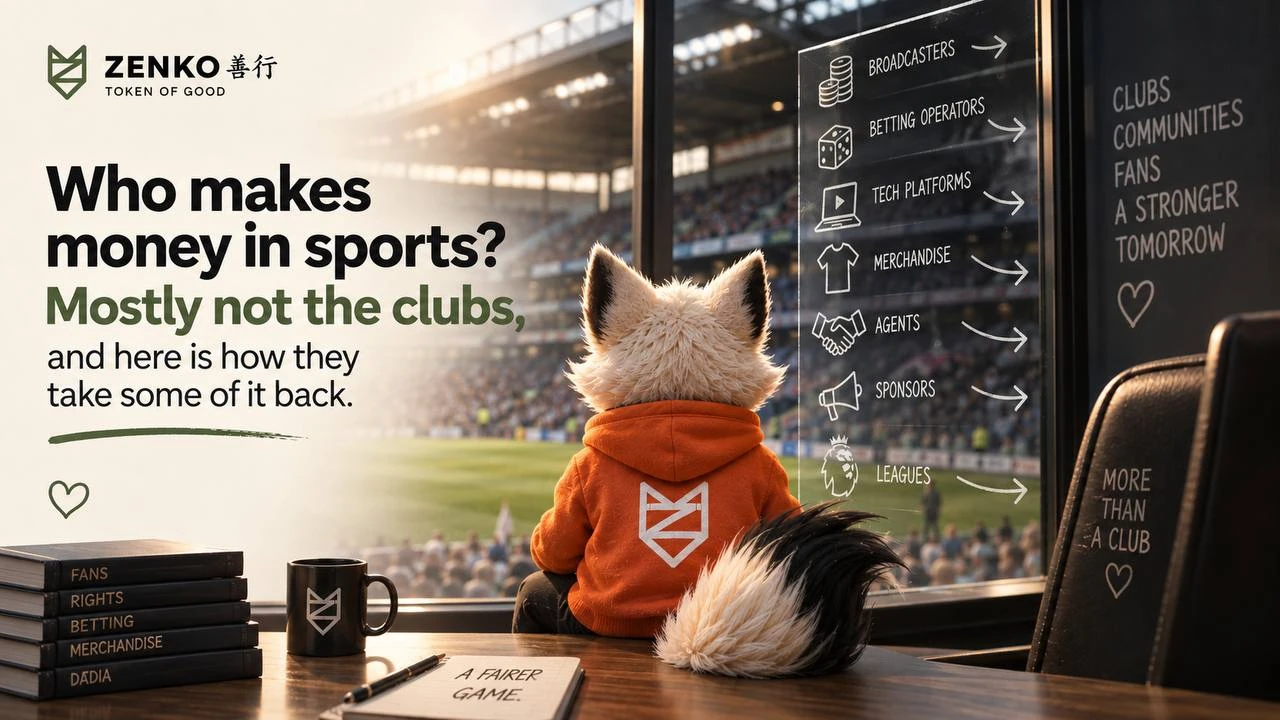
Sport is monetised in six layers: media rights, sponsorship, matchday, merchandise and licensing, betting, and the technology and data that sit between fans and clubs. The clubs and leagues that make the product capture the majority of one of those layers, sponsorship. The rest is mostly kept by whoever sits between the fan and the rights holder: the broadcaster, the sportsbook, the resale platform, the licensee, the app.
That is the short answer. The rest of this series is the long one, and it is worth reading before the next fan engagement contract crosses your desk, because most of the money that leaks out of the game leaks at moments a club could control.
How big is the sports industry?
It depends who is counting. Statista sized the global sports industry at $417bn in 2025. The Business Research Company put it at $495bn for the same year, heading for $654bn by 2030 at 5.8% a year. Widen the definition to include participation, equipment and recreation and Global Sports Insights arrives at $2.86tn, which would make sport the eighth largest industry in the world. The spread comes from scope, and any figure you read should arrive with the firm's name attached. Every number in this series does.
Whichever total you prefer, the shape underneath is the same. One product, the competition and the people and IP that make it, is sold through six commercial layers. Here is what each layer is worth and how much of it comes back to the people who made the product.
The six layers and who keeps the money
| Layer | Size | What reaches the rights holder |
|---|---|---|
| Media rights | $62.61bn globally in 2024 (SportBusiness Global Media Report) | Paid to leagues and pooled at the top. The 72 EFL clubs share roughly £100m a year in solidarity, about 5 to 7% of Premier League broadcast revenue. |
| Sponsorship | $65.7bn to $91.7bn in 2025 depending on scope (Straits Research; Fortune Business Insights) | Flows directly. Commercial income is 44% of revenue across Deloitte Money League clubs (2025 edition). |
| Matchday and ticketing | 18% of Money League revenue (Deloitte, 2025). Ticket resale roughly $15bn a year globally (analysts cited by the Boston Globe, March 2026) | Face value reaches the club. The resale spread reaches the platform. |
| Merchandise and licensing | Fanatics alone: $8.1bn revenue in 2024 (CFO Glenn Schiffman to Sportico, January 2025) | Leagues and partners receive roughly 6 to 8% of retail sales under the licensing model. |
| Betting | $16.96bn US operator revenue in 2025 (American Gaming Association) | Projected direct league share of about $900m a year, on a 2018 projection (AGA with Nielsen Sports). |
| Technology and data | Fan engagement platforms about $5.9bn in 2024 (GMInsights; Credence Research) | Depends entirely on who owns the fan identity. |
Two of these get a sentence here and a full article each in the series. Betting captures fan attention on a scale nothing else matches, and almost none of the operator's margin travels back to the league that supplied the fixture Sports betting made $17bn in the US last year. How much reached the leagues?. Merchandise is the clearest example of an intermediary owning the customer. Fanatics holds a database of more than 100 million identified fans and pays the league a single-digit royalty on the shirt Fanatics made $8.1bn. The league got 6 to 8% of the shirt.
Why the elite are fine and everyone else is waiting
Deloitte's Football Money League gives the cleanest read on how the biggest clubs earn. In the 2025 edition, covering 2023/24, the 20 clubs generated €11.2bn, an average of €560m each, split 44% commercial, 38% broadcast, 18% matchday. Real Madrid became the first club past €1bn in a season. The 2026 edition took the total to €12.4bn and commercial income past €5bn, the first stream to get there.
Look inside the table and it splits. For the top ten, commercial income is 48% of the total. For clubs ranked 11 to 20, broadcast is 47%. Below the Money League the dependence on central money steepens fast. In 2024/25 a Championship club received about £8m in solidarity, a League One club about £360,000 to £400,000, a League Two club about £240,000, while a club relegated from the Premier League received about £49m in year-one parachute payments Where does Premier League TV money go? Not far down the pyramid.
The clubs that have diversified are the ones with brands big enough to sell directly to a global audience. Everyone else is waiting on a central pot that pools at the top and trickles down, and on the independent regulator created by the Football Governance Act 2025, which can impose distribution conditions if the leagues cannot agree. That may change things in time. A League Two commercial director cannot plan a season around it.
The fan the club cannot name
Here is the number that explains most of the rest. According to Dizplai's Anonymous Fan Index (January 2026), rights holders can identify about 24% of their audience by name and contact. Roughly one fan in four. The other three are followers on someone else's platform, viewers on someone else's channel, buyers in someone else's shop.
Set that against Fanatics' 100 million named fans and you have the whole problem in one comparison. The intermediary knows who the fan is. The club, the thing the fan actually cares about, does not.
It can be fixed quickly. Two Circles built European club rugby body EPCR a known audience from a standing start in three months, with a data warehouse and the largest fan survey the sport had run Fan engagement is a first-party data problem. Known audience first, everything else after.
What has already been tried
Sport has had one big wave of fan-owned digital products, and most of it is under water. Chiliz, the company behind Socios fan tokens for more than 170 sports organisations, trades about 96% below its 2021 peak, with a market cap around $257m in mid-2026. NBA Top Shot went from $224m of sales in February 2021 to about $2.9m a month by February 2023, a fall of more than 95% (Benzinga, citing CryptoSlam). Sorare's revenue fell from $63.9m in 2023 to $46.5m in 2024. The pattern was the same each time: unlimited supply, speculative buyers, and very little to do with the thing once you owned it Fan tokens fell 96%. What actually survived the digital collectibles crash.
Three models compounded through the same period. Fanatics, which combined commerce, collectibles and data. Two Circles, which started with the known audience. And graded physical collectibles, where Fanatics' card business grew from $368m in 2020 to $1.6bn in 2024 while the buyer base got younger, more digital and more female Who is buying sports collectibles now, and why it matters for your club. Each of them was data-led, gave the fan something with real use, and put the rights holder closer to the fan.
The four things a club needs
Read across the evidence and the list is short.
A reason for fans to identify themselves. An honest value exchange works better than a lead magnet: play a prediction game, hit a movement target, buy a shirt, and get something for it, with an outcome attached that you can see.
A revenue line per engaged fan. Measured, owned by the club, and separate from any licensee's margin.
An impact layer sponsors will fund. Sponsorship budgets are moving from exposure to measurable outcomes. A pre-funded impact pool, counted in meals, gives a sponsor a number it can report and gives the fan a reason to put a name to the action Doing good is the fan monetisation model.
A way to start without betting the budget. This is where most fan engagement projects die: the club wants a guaranteed floor before it commits its brand, the builder cannot guarantee anything without a funded deployment, and the capital wants a live deal first. A minimum guarantee, underwritten by someone other than the club, breaks the deadlock Why fan engagement projects stall at clubs, and what a minimum guarantee changes.
Where we fit
We build the first three. Predictfully is a club-branded, free-to-play prediction game that creates a fan identity at sign-up. Move for Good is a sponsor-funded movement challenge where fans direct a pre-funded impact pool. Shop for Good puts a free digital collectible on every shirt and turns the purchase into meals. One identity runs through all of it, and the club owns it.
Touchline Capital supplies the fourth. It is the capital layer that underwrites a club's minimum guarantee so the programme starts this season. We are a platform partner on its roster, and the first deals on its slate are ours to deliver. The sequence, from prediction game to shirt drop in ninety days, is written up here A 90-day plan to give your club a fan revenue line.
The series
- Sports betting made $17bn in the US last year. How much reached the leagues?
- Where does Premier League TV money go? Not far down the pyramid
- Fanatics made $8.1bn. The league got 6 to 8% of the shirt
- Fan tokens fell 96%. What actually survived the digital collectibles crash
- Who is buying sports collectibles now, and why it matters for your club
- Fan engagement is a first-party data problem
- Why fan engagement projects stall at clubs, and what a minimum guarantee changes
- Doing good is the fan monetisation model
- A 90-day plan to give your club a fan revenue line
FAQ
How much money is in the sports industry? Between $417bn (Statista, 2025) and $495bn (The Business Research Company, 2025) on the common definition. Wider definitions that include participation and equipment run to $2.86tn (Global Sports Insights, 2025).
How do football clubs make money? For the biggest 20 clubs, 44% commercial, 38% broadcast and 18% matchday (Deloitte Money League, 2025 edition). Below that level, broadcast and central distributions dominate, and the smaller the club the more it depends on them.
Where does Premier League TV money go? Mostly to Premier League clubs. Around £100m a year reaches the 72 EFL clubs as solidarity, about 5 to 7% of broadcast revenue, distributed steeply by division Where does Premier League TV money go? Not far down the pyramid.
What is fan engagement technology? The tools rights holders use to own the fan relationship directly: prediction games, loyalty and rewards, direct commerce, data platforms. The platform market was about $5.9bn in 2024 (GMInsights; Credence Research).
Do fan tokens make money for clubs? Some did during 2021. Chiliz reports more than $700m delivered to sports partners over its life, and its token trades about 96% below its 2021 peak. Durable value has come from products fans use Fan tokens fell 96%. What actually survived the digital collectibles crash.