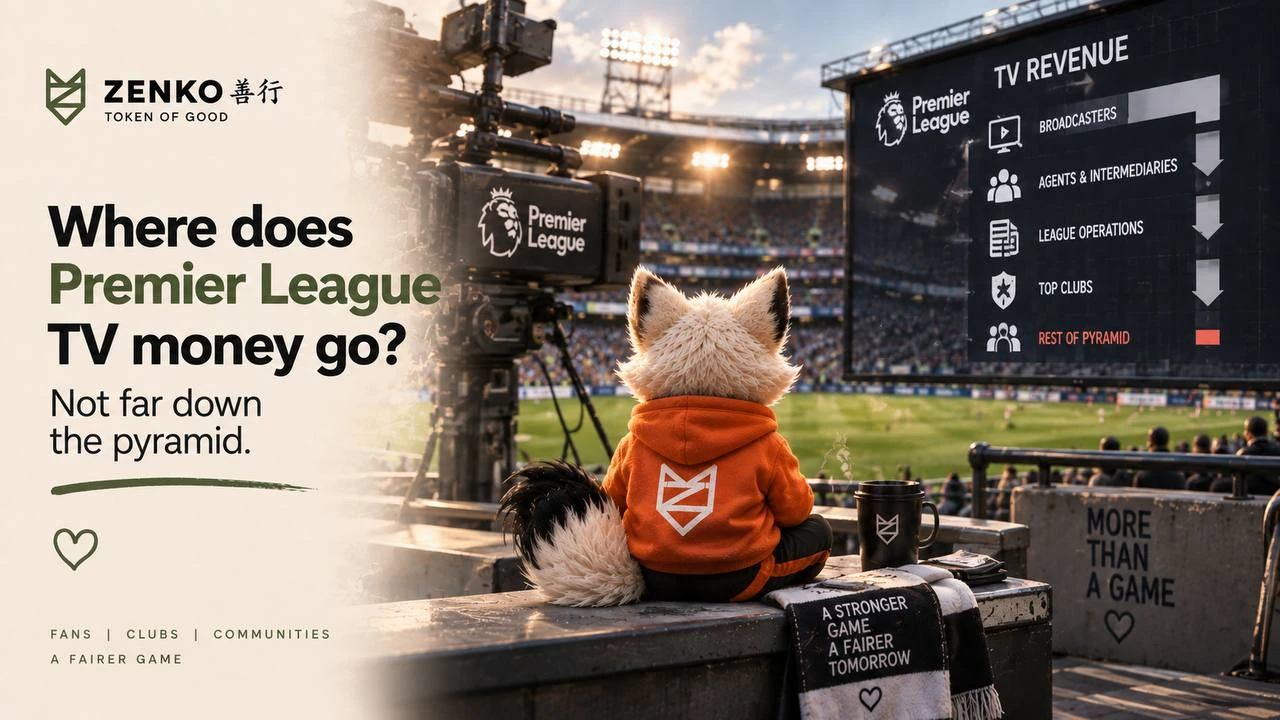
Global sports media rights were worth $62.61bn in 2024, according to SportBusiness. The Premier League's share is about $4.2bn a year. Of that, roughly £100m reaches the 72 EFL clubs as solidarity, about 5 to 7% of the league's broadcast revenue, distributed so steeply that a League Two club received about £240,000 in 2024/25 while a club relegated from the Premier League received about £49m in its first parachute year.
How big is the media rights market?
The SportBusiness Global Media Report 2024 recorded the first year above $60bn: $62.61bn, up 12% on 2023's $55.85bn, lifted by the Paris Olympics and Euro 2024. In 2025 the figure sits slightly under $58bn, a dip with no mega-event in the calendar, and 2026, a World Cup year, is projected at $66.42bn. Football and American football between them account for 54.5% of the total. The NFL alone commands about $12.6bn a year in global rights, roughly triple its nearest rival, followed by the Premier League at about $4.2bn and the NBA at about $4.0bn. In the US, S&P Global estimated TV and streaming sports rights at $29.54bn in 2024, heading toward $35bn by 2027; the NFL's current eleven-year contracts with Fox, Paramount, Disney and Amazon are worth more than $110bn in aggregate.
SportBusiness's own reading of its market is that it is thriving at the top while properties outside the top tiers struggle to hold their value. That single sentence describes the whole pyramid.
How much reaches the EFL?
Solidarity payments to the 72 EFL clubs total roughly £100m a year, about 5 to 7% of the Premier League's broadcast revenue. The distribution is steeply hierarchical. For 2024/25, a Championship club received about £8m, which is 30% of a year-three parachute payment. A League One club received about £360,000 to £400,000, or 4.5% of that figure. A League Two club received about £240,000, or 3%. A club relegated from the Premier League, meanwhile, received parachute payments of about £49m in its first year down.
The Premier League has a long-standing pledge to invest 5% of its broadcast revenue in the grassroots game. Written evidence to Parliament from Dr David Webber sets out that the pledge remains unmet. EFL chair Rick Parry has argued for replacing parachute payments with a 25% pooled, merit-based share across all four divisions, on the grounds that the current model distorts competition. The Football Governance Act 2025 created an independent regulator with the power to impose distribution conditions if the leagues cannot agree between themselves.
What a lower-league club actually controls
Take the League Two case. About £240,000 a year in solidarity. A regulator that may, at some point, redistribute more. A proposal from the EFL chair that the Premier League has not accepted. None of that is a budget line for this season.
What the club does control is its relationship with its own supporters, and that is where the gap is. Rights holders can identify about 24% of their audience by name and contact (Dizplai Anonymous Fan Index, January 2026). Three fans in four are unknown to the club they follow. A revenue line built directly, per engaged fan, is the one line that nobody in London or Zurich decides.
Building it does not need a budget the club does not have. A club-branded prediction game, a sponsor-funded movement challenge and a digital collectible on the shirt all run on sponsor money that arrives at activation, and the club's minimum guarantee for the season can be underwritten by a capital partner before anything signs Why fan engagement projects stall at clubs, and what a minimum guarantee changes. The towns around lower-league clubs are also where community need concentrates, which is why the impact side of this is strongest at the base of the pyramid. A sponsor pays for verified outcomes, and a club at this level has the relationships to deliver them Doing good is the fan monetisation model.
That is the argument of this series in one paragraph. The central money will do what it does. The direct line is the club's to build.
FAQ
How much do EFL clubs get from the Premier League? About £100m a year in total across 72 clubs, roughly 5 to 7% of Premier League broadcast revenue. In 2024/25 that meant about £8m for a Championship club, £360,000 to £400,000 for a League One club and £240,000 for a League Two club.
What are parachute payments? Payments to clubs relegated from the Premier League to cushion the drop in broadcast income. A relegated club received about £49m in year one for 2024/25.
What is the Football Governance Act 2025? The Act that created an independent football regulator for England, with powers that include imposing distribution conditions on broadcast revenue if the leagues fail to agree.
How much are Premier League TV rights worth? About $4.2bn a year globally (SportBusiness Global Media Report 2024), second only to the NFL at about $12.6bn.