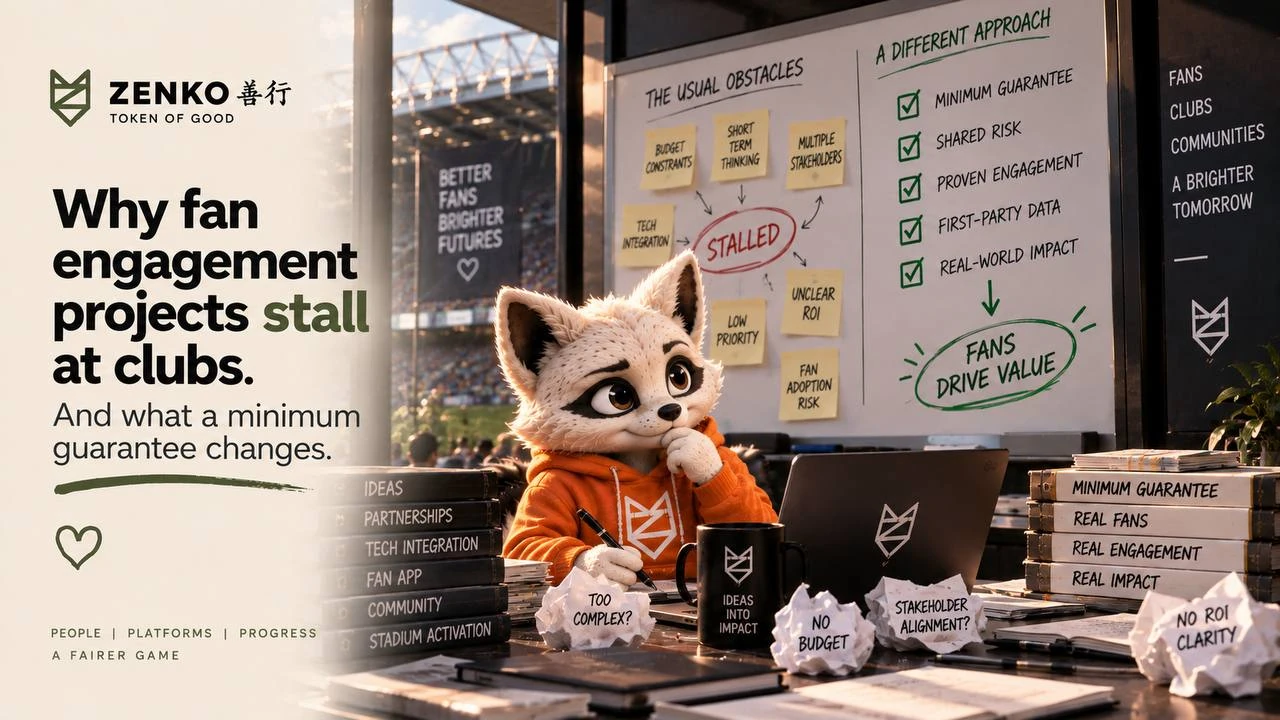
Most fan engagement projects at clubs below the elite stall at the same moment. The club wants guaranteed income before it commits its brand and its fans. The builder cannot guarantee anything without a funded deployment. The capital wants a live, proven deal before it funds one. Three parties, three vetoes, and a market stuck at cents per fan. A minimum guaranteed income, underwritten by someone other than the club, removes the club's veto. Touchline Capital exists to underwrite it.
The squeeze
The structure of the problem is in the numbers from the rest of this series. Clubs outside the top ten are broadcast-dependent: 47% of revenue for Money League clubs ranked 11 to 20 (Deloitte, 2025 edition), and far more than that below the Money League, where a League One club receives £360,000 to £400,000 a year in solidarity and a League Two club about £240,000 Where does Premier League TV money go? Not far down the pyramid. The fan engagement sector that is supposed to fix this is about $5.9bn in total (GMInsights; Credence Research), small against the value it is trying to recapture Fan engagement is a first-party data problem.
What we can add to the numbers is what happens in the room, because we spent two years there. Working platforms, signed letters of intent, and every conversation ending at the same place: prove it works, then we will fund it. The model needs the money to prove it works.
The pattern at a club is consistent enough to describe without a percentage attached, because we have not measured it and will not invent one. The pitch lands. The commercial team likes the tools. Nothing starts. There is no budget line for it, there is no digital headcount to run it, and nobody wants to be the club that launched something that failed. All three are reasonable. None of them is about whether the products work.
What a minimum guarantee changes
A minimum guaranteed income gives the club a known floor for the season. The programme is delivered against that floor, and the club shares in what the programme generates above the guarantee and its costs. If the programme underperforms, the club still receives the guarantee. That is what the guarantee is for. The club's downside is its time and its badge.
The mechanism, in the order it happens. Terms are agreed by letter of intent between the club, the platform partner and Touchline Capital, including the minimum guaranteed income. Capital sits in the Activation Pool, a transparent on-chain escrow, and locks visibly against the deal. Funds ready, the deal signs inside its committed window. The platform deploys and fans start playing, moving and buying. Revenue repays the guarantee and the costs first. Only then does revenue share begin, on disclosed terms, between the club, the platform and Touchline. A share of every completed deal flows back into the pool to fund the next one.
Every deal carries one of three public labels: Under LOI, Activated, Distributing. Under LOI is not Activated, and nobody is allowed to describe a deal as more than it is. A deal that misses its window releases its capital back to the pool, in public.
The first deal on Touchline's slate has exactly this shape: a club-branded, free-to-play prediction game with a League One or League Two club, under letter of intent, with the club named at signature and not before. Touchline also has a membership community, The Agency, which launches soon and is subject to change until it does.
What the club supplies
A badge. A shirt SKU. One commercial contact. A sponsor introduction. That is the list. The club does not need a budget line, because the guarantee is underwritten and the rewards are sponsor-funded before they open, and it does not need a developer, because the platform is built. The ninety-day sequence, from prediction game to shirt drop, is here A 90-day plan to give your club a fan revenue line.
FAQ
What is a minimum guarantee in a sports partnership? A floor. The rights holder receives at least an agreed amount for the term of the deal, whatever the programme generates, with revenue above the guarantee and costs shared on disclosed terms.
How can lower league clubs increase revenue? By building a direct revenue line with their own supporters, per engaged fan, funded by sponsors who pay for measurable outcomes, with the season's minimum guarantee underwritten so the club is not carrying the launch risk.
Does the club have to pay for a fan engagement platform? In this model, no. The minimum guarantee is underwritten by Touchline Capital and the rewards are funded by sponsors before they open. The club supplies its badge, a shirt SKU, a commercial contact and a sponsor introduction.
What is Touchline Capital? The capital layer for sport. It funds and underwrites the deals that put fan engagement tools to work, recoups first, and publishes the status of every deal under one of three labels.