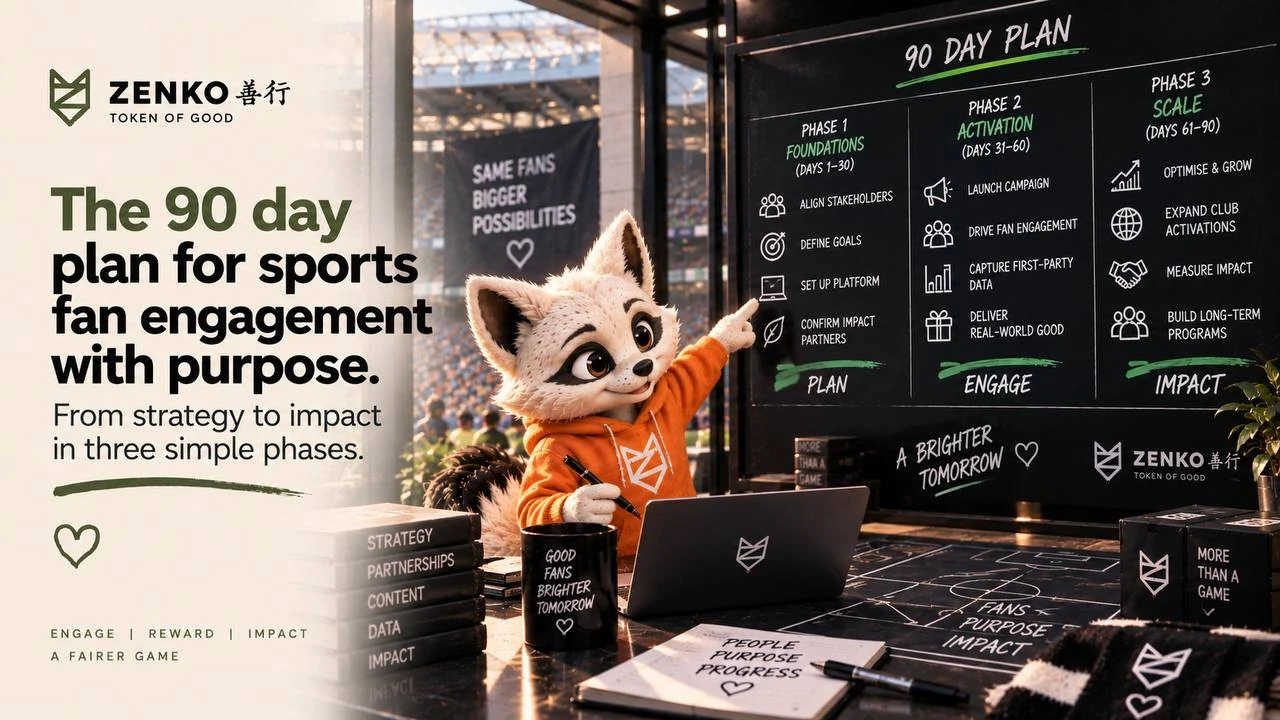
In ninety days a club can go from no owned fan data to three live products, one identity across all of them, a sponsor-funded reward and impact pool, and a revenue line measured per engaged fan, with the season's minimum guarantee underwritten before anything signs. The order matters more than the speed. Here it is.
Days 0 to 30: the prediction game
Start with Predictfully, a club-branded, free-to-play prediction game. Points, leaderboards and prizes, with no money markets anywhere near it. The fan creates an identity at sign-up, and that identity is the record everything else attaches to. A sponsor attaches to the prize pool before the first round opens.
Measure named fans and weekly actives.
Why first: it is the lowest-friction product, its weekly rhythm follows the fixture list, it needs no stock and no delivery, and it captures the prediction moment that currently lives in a sportsbook app the club does not own Sports betting made $17bn in the US last year. How much reached the leagues?. This is the shape of the first deal on Touchline Capital's slate, under letter of intent.
Days 30 to 60: Move for Good
Add the movement challenge. A sponsor funds an impact pool before it opens. Fans move, and by hitting targets they direct that pool to outcomes they can see, counted in meals.
Measure engaged fans and meals directed.
Why second: the sponsor's money arrives at activation, so this is the fastest part of the programme to start paying; the identity from the prediction game carries straight across; and it reaches a different supporter, because the fan who runs on a Sunday morning is often not the one who predicts on a Saturday afternoon Doing good is the fan monetisation model.
Days 60 to 90: Shop for Good
Attach a free digital collectible to every shirt. The buyer claims it, the club captures the identity at the point of purchase, and the purchase funds meals. Time it to a kit drop or a matchday retail moment.
Measure identified buyers and revenue share.
Why third: it needs the shirt SKU and the retail moment to be ready, and by day sixty the club has a base of named fans to sell it to Fanatics made $8.1bn. The league got 6 to 8% of the shirt. The collectible is fixed in supply, earned, and tied to an outcome, which is the design the rest of the market learned the hard way Fan tokens fell 96%. What actually survived the digital collectibles crash.
The scorecard
Five numbers, reported every month. Named fans. Engaged fans. Revenue per engaged fan. Sponsor outcomes. Meals delivered.
The working benchmark we set ourselves is at least $1 of measurable value per engaged fan. That figure is a target we report against, labelled as illustrative and not a forecast, and it is there so that the club, the sponsor and we are all counting the same thing.
What the club supplies
A badge. A shirt SKU. One commercial contact. A sponsor introduction.
What the club does not need: a budget line, because the season's minimum guarantee is underwritten by Touchline Capital and the rewards are funded by sponsors before they open Why fan engagement projects stall at clubs, and what a minimum guarantee changes; or a developer, because the products are built. Token earning and any cash-out across the products are restricted to over-18s, and the age gate is part of the sign-up.
FAQ
How do you launch a fan engagement programme at a football club? Start with the product that creates identity with the least friction, a free-to-play prediction game, then add sponsor-funded movement challenges and a collectible on the shirt, all on one fan record.
What should a football club measure in fan engagement? Named fans, engaged fans, revenue per engaged fan, sponsor outcomes and impact units delivered. Followers and impressions are inputs, and they are somebody else's data.
How long does it take to set up a club prediction game? With a built platform and a sponsor attached, the first round can open inside the first month.
Does a club need a developer to run this? No. The products are built and delivered by the platform partner. The club supplies its badge, a shirt SKU, a commercial contact and a sponsor introduction.