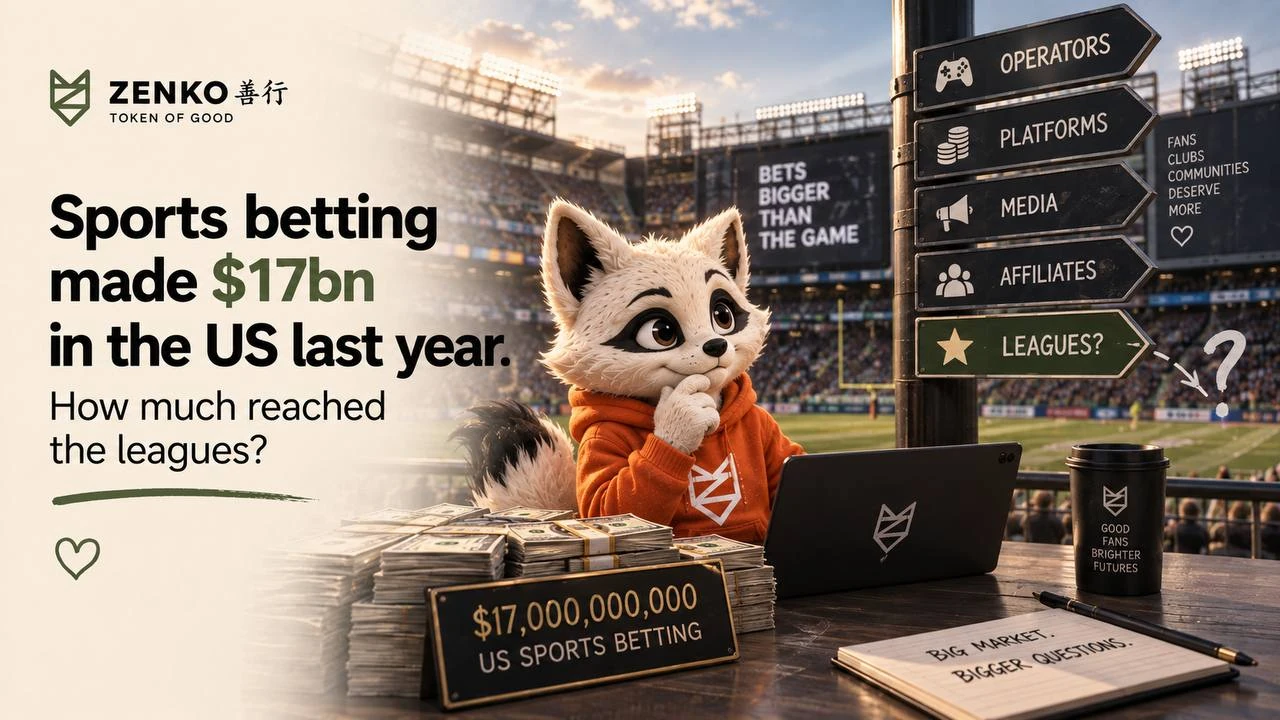
In 2025, US sportsbooks kept $16.96bn in revenue from $166.94bn wagered, according to the American Gaming Association's Commercial Gaming Revenue Tracker. The leagues whose fixtures made every one of those bets possible take a direct share that the industry's own study projected at about $900m a year, most of it as advertising, sponsorship and data fees. The rest of what leagues gain from betting is a halo: more engaged fans spending more on tickets, shirts and subscriptions. Useful and real, and the fan pays for it.
How big is sports betting now?
Global estimates cluster between $100bn and $160bn for 2025. IMARC put it at $111.9bn, Grand View at $111.2bn, Precedence at $112.26bn and ResearchAndMarkets at $155.4bn. Forecasts run to $225bn to $325bn by the early to mid 2030s. Cite the firm; the scope varies.
The US is the clearest picture because it is the newest and best measured regulated market. Before the Supreme Court's Murphy v. NCAA decision in 2018, legal single-game betting existed in one state. By 2025 it was legal in 39 states plus Washington DC, with more than 80% of wagers placed on mobile. The AGA's full-year 2025 figures: revenue $16.96bn, up 22.8%; handle $166.94bn, up 11%; state taxes $3.71bn, up 32.4%. A parallel estimate from RG.org lands within rounding of all three.
What do the leagues actually get?
The reference study is the 2018 AGA and Nielsen Sports projection of what the four major US leagues would gain from widespread legal betting. The headline was $4.2bn a year across the NFL, MLB, NBA and NHL. The detail is the part worth remembering: nearly 80% of that, about $3.3bn, was indirect. It comes from fans who bet being more engaged and therefore spending more on sponsor-linked products, merchandise, tickets and media. The direct revenue, from operators buying advertising, sponsorship and data, was projected at about $900m. By league, indirect included: NFL $2.3bn, MLB $1.1bn, NBA $585m, NHL $216m.
Data rights, the one payment that flows straight from operator to league for the product itself, were projected at about $25m a year for the NBA and $28m for MLB. Against operator revenue of $16.96bn, those are small numbers.
Two caveats travel with this. The study was produced in 2018 as advocacy material for legalisation, it assumed full nationwide availability, and it excluded integrity or royalty fees. The projections are projections. The shape of the argument has held up since, which is why it is still the study everyone quotes.
The number that would change the argument
Several US states have debated a royalty or integrity fee for leagues of between 0.25% and 1% of handle. On 2025 handle of $166.94bn that would be about $417m at the low end and about $1.67bn at the top, which is arithmetic on the AGA figure and nothing more. Even the low end is close to half the projected direct revenue for all four leagues combined, and the top end would nearly double it. Nobody has passed one yet.
Where the attention actually lives
The bet is the last step in a sequence. Before it comes the prediction: who wins, who scores first, what the score is at half time. Every fan makes those predictions whether or not they ever place a bet, and at the moment that attention is captured, if it is captured at all, a sportsbook app the club does not own is doing the capturing.
A club can own that moment. A club-branded, free-to-play prediction game gives fans a place to make the same predictions for points, leaderboards and prizes, with no money markets anywhere near it. The fan creates an identity to play, so the club learns who they are. A sponsor attaches to the prize pool, so the club has a measurable engagement product to sell. Predictfully is our version of that game, and it is the product in the first deal on Touchline Capital's slate, a League One or League Two club under letter of intent.
To be clear about what we are claiming. A prediction game does not earn what a sportsbook earns, and we keep betting revenue per user off the same chart as club revenue per fan because they measure different things. The claim is narrower and more useful: the club gets the fan's name and the sponsor gets verified engagement, and neither of those exists while the attention lives in someone else's app. The rest of the identity argument is here Fan engagement is a first-party data problem, and the order to build it in is here A 90-day plan to give your club a fan revenue line.
FAQ
How much did sports betting make in 2025? US sportsbooks generated $16.96bn in revenue on $166.94bn of handle (American Gaming Association, full year 2025). Global market estimates range from $111bn to $155bn (IMARC; Grand View; Precedence; ResearchAndMarkets).
Do sports leagues get a cut of betting revenue? Directly, only through advertising, sponsorship and data deals with operators. The 2018 AGA and Nielsen Sports study projected about $900m a year in direct revenue for the four major US leagues, against $3.3bn of indirect gains.
What are data rights fees in sports betting? Payments from operators to leagues for official data feeds. The 2018 projection put them at about $25m a year for the NBA and $28m for MLB.
Is a free-to-play prediction game gambling? No. Points, leaderboards and prizes with no stake and no money markets. Predictfully runs that way, and any token earning or cash-out across our products is restricted to over-18s.