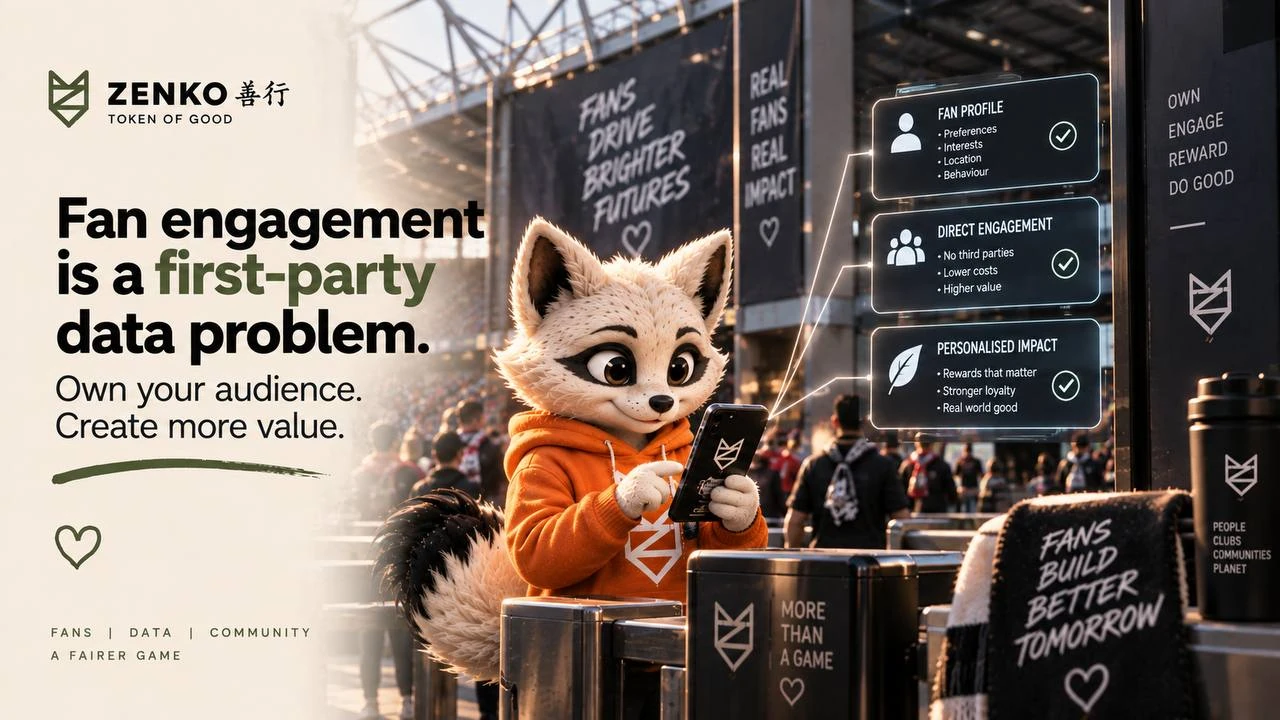
Rights holders can identify about 24% of their audience by name and contact, according to Dizplai's Anonymous Fan Index (January 2026). Fan engagement technology, a market of about $5.9bn in 2024 growing at around 16% a year (GMInsights; Credence Research), exists to fix that number. Everything else it does, the games, the rewards, the content, is in service of one outcome: a fan the club can name, reach and sell to directly.
How big is fan engagement technology?
The estimates come from lower-tier research aggregators and the range is wide, so we cite the firm and move on. GMInsights sized the fan engagement platform market at $5.9bn in 2024 growing 16.3% a year to 2034. Credence Research had $5.89bn in 2024 rising to $19.05bn by 2032. The Business Research Company's broader fan engagement market is projected at $20.94bn by 2030 at 20.9%. Sports technology as a whole was $21.51bn in 2025 heading to $135.91bn by 2035, per Precedence Research. Small next to the value it is trying to recapture, which is the point.
What the prize actually is
Three players show the shape of it.
Two Circles built European club rugby body EPCR a known audience from a standing start in three months, with a data warehouse and the biggest fan survey the sport had run. Known audience first, personalised marketing second.
Fanatics holds more than 100 million identified fans and used that base to build commerce, collectibles and a betting business on top Fanatics made $8.1bn. The league got 6 to 8% of the shirt.
The fan-token generation tried to get there through tradeable assets and mostly lost the audience when the price fell Fan tokens fell 96%. What actually survived the digital collectibles crash.
The common thread is that the value sits in the identity and the transaction, and whoever owns those two things sets the terms. At the moment, for most clubs, that is the broadcaster, the sportsbook, the kit licensee and the social platform.
What sponsors now pay for
Sponsorship is the one revenue stream that flows directly to rights holders, and it is the largest line for elite clubs at 44% of Money League revenue (Deloitte, 2025 edition). The market is sized at $65.71bn (Straits Research), $70.2bn (The Business Research Company) or $91.69bn (Fortune Business Insights, heading to $181.38bn by 2034) for 2025, depending on scope.
The shift inside those numbers matters more than the totals. Sponsorship is moving from passive exposure, a logo on a shirt or a board, to partnerships tied to measurable outcomes: app downloads, leads, engagement, verified actions. A sponsor that can report what it got is a sponsor that renews. That is the same shift we have spent years working through with brands outside sport, where a lead is only worth what it converts to acquisition economics cluster.
Performance marketing 3.0, at a club
Here is the model we run with brands, translated to a club.
The sponsor's budget funds a reward pool and an impact pool before anything opens. Fans identify themselves to earn from it, by playing a prediction round, hitting a movement target or buying a shirt. The club owns the resulting identity and the data that comes with it. The sponsor receives measured outcomes, and a verified impact figure it can put in a report.
Two principles hold it together. External capital enters before rewards leave: no prize, reward or impact opens without its budget in place from the party that benefits. And the sponsor pays for verified outcomes, so the club is selling something a sponsor can count.
The arithmetic that makes it worth doing is small numbers multiplied by large audiences. A rights holder with five million followers that earns one more dollar per follower, directly, has created five million of new annual revenue, most of it from a relationship it finally owns. That is illustrative arithmetic on a hypothetical, and we label it that way wherever it appears. The point is the shape: small per-fan gains, large absolute gains.
What it takes at a club
One identity that runs across every product, so the prediction player and the shirt buyer are the same record. Somewhere to keep it that the club controls. A sponsor who wants outcomes. And a way to start without the club finding the budget first, which is where most of these projects die Why fan engagement projects stall at clubs, and what a minimum guarantee changes. The sequence that gets a club there in ninety days is written up here A 90-day plan to give your club a fan revenue line.
FAQ
What is a fan engagement platform? Software that lets a rights holder run games, rewards, content and commerce with fans directly, and capture the identity and data that result. The market was about $5.9bn in 2024 (GMInsights; Credence Research).
What is first-party fan data? Data a rights holder collects directly from fans who have identified themselves, as opposed to audience data held by a broadcaster, platform or licensee.
How do sponsors measure ROI in sport? Increasingly through measurable outcomes such as downloads, leads, engagement and verified actions, in place of exposure metrics alone.
How many of their fans can clubs identify? About 24% by name and contact, according to Dizplai's Anonymous Fan Index (January 2026).