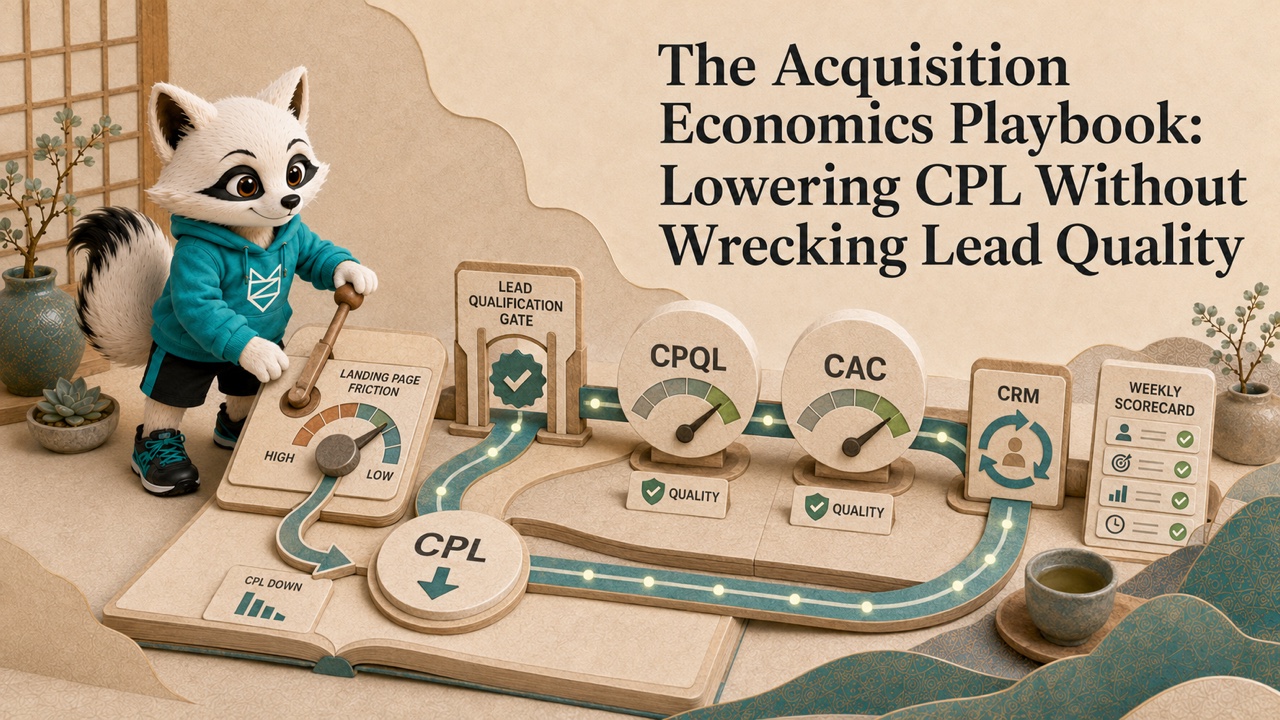
Cost per lead is the easiest acquisition number to measure and the easiest one to misread. A cheap lead that never becomes a customer isn't cheap. It's a cost that hasn't been recognised yet. This playbook is six pieces that work through the problem in order: what CPL actually measures, how to tell it apart from CPQL and CAC, how to diagnose a spike, how to track all three together, how to stop sales and marketing arguing about what "qualified" means, and how much friction a form should really carry.
Read them in order if you're starting from scratch, or jump to the one that matches the problem in front of you today.
The seven-piece acquisition economics framework
1. How to Reduce Cost Per Lead Without Sacrificing Lead Quality
The starting point. It makes the core case: CPL only comes down sustainably through relevance across audience, message, landing page and follow-up, not through cutting bids or widening targeting. It covers the practical levers that lower cost without lowering quality, why raw CPL alone hides more than it reveals, and why speed of follow-up decides whether a well-earned lead ever converts.
2. CPL vs CPQL vs CAC: Which Metric Owns Which Decision?
The framework the rest of the series relies on. CPL, CPQL and CAC each answer a different question and belong to a different decision: campaign optimisation, targeting and qualification, and whether the business model works. This piece explains why using one metric to make a call that belongs to another is the most common acquisition-economics mistake, and who on the team should own each number.
3. Why Is My Cost Per Lead So High? A Practical Guide
The diagnostic. When CPL spikes, this is the checklist: rule out an invalid benchmark comparison first, then work through platform-wide cost rises, targeting mismatch, creative fatigue, landing page friction, broken tracking, and bidding or pacing issues. It is built to stop teams cutting budget on a problem a budget cut cannot fix.
4. The Weekly Acquisition-Economics Scorecard
The operating rhythm. A practical template and the CRM feedback loop needed to keep CPL, CPQL and CAC visible together every week, plus the decision rules that turn the scorecard into something that triggers action rather than just getting glanced at.
5. How to Build a Lead Qualification Framework Sales and Marketing Actually Agree On
The definition both teams need before any of the above works properly. Written, observable MQL and SQL criteria, a response-time SLA with commitments on both sides, and a rejection-logging process that turns "these leads are bad" from a recurring argument into an actual feedback loop.
6. How Much Landing Page Friction Should You Really Remove?
The form question everyone eventually asks. Not all friction is bad; some of it is doing genuine qualifying work. This guide gives you a field-by-field audit method for telling useful friction from clutter, and explains why testing form changes against conversion rate alone routinely produces the wrong answer.
7. The Paid-Growth Saturation Test
The next-pound decision. When ROAS slides, this five-branch worksheet separates marginal-CAC decline, audience saturation, genuine creative fatigue, offer weakness and delivery capacity before another creative brief or budget increase goes out. It turns the series into a scale, hold, revise or stop decision.
The thread that runs through all seven
Every piece in this series makes the same underlying argument from a different angle: the cheapest lead and the best lead are rarely the same lead. Most acquisition-economics mistakes come from optimising for the number that's easiest to measure rather than the one that actually matters for the decision at hand.
Where genuine, honestly earned participation replaces a low-friction lead magnet or a discount tripwire, that gap can close. The qualifying signal is built into the action itself rather than bolted on afterwards through a form or a sales call. That's the model behind Zenko's reward-based campaigns, and it is referenced throughout this series where it is relevant to the problem being diagnosed, not as a blanket claim that it fixes everything on this list.
FAQ
Is a lower CPL always better? No. A lower CPL only matters if lead quality and downstream conversion hold steady or improve. Track cost per qualified lead and cost per opportunity alongside raw CPL before deciding a channel is working.
What's the difference between CPL, CPQL and CAC? CPL measures cost per inquiry, regardless of quality. CPQL measures cost per lead that meets defined qualification criteria. CAC measures the fully loaded cost of acquiring a paying customer. Each one is built to drive a different decision.
What causes high CPL? Usually one of six things: an invalid benchmark comparison, rising platform-wide costs, an audience or targeting mismatch, creative fatigue, landing page friction, or broken tracking under-counting real conversions. Work through them in that order before touching budget.
How do you calculate qualified CPL? Divide total spend by the number of leads that meet your actual qualification criteria, such as firmographic fit, verified intent and budget authority, rather than the raw number of form completions.
What is a good CPL? There isn't a universal benchmark. CPL varies substantially across industries and channels. A CPL is good when it produces an acceptable cost per customer against your specific margins and lifetime value, not when it matches an average from an unrelated industry.
Which metric should decide whether to cut a channel? CAC, benchmarked against customer lifetime value, not CPL. A channel with a high raw CPL can still be your most efficient source of customers if its qualification and close rates are strong enough.
What's the difference between an MQL and an SQL? An MQL meets fit criteria marketing can check from data already available. An SQL has been validated on an actual conversation against budget, authority, need and timeline. MQL is marketing's call; SQL is sales' call, made on evidence rather than instinct.
Should I remove form fields to improve conversion rate? Only after checking what those fields are doing for qualification. Removing a field that filters for genuine fit can raise conversion rate while lowering lead quality and SQL rate, which is a worse outcome dressed up as a win.
How often should CPL, CPQL and CAC each be reviewed? CPL weekly, sometimes daily at the campaign level. CPQL weekly once CRM data is flowing reliably. CAC monthly or quarterly, but kept visible on a weekly view as a trailing figure rather than absent entirely.
Why does speed of follow-up matter this much for lead quality? In the original Lead Response Management study, leads contacted within five minutes were 21 times more likely to qualify than leads contacted after 30 minutes. A slow follow-up process can undo improvements made earlier in the funnel.
Start with How to Reduce Cost Per Lead Without Sacrificing Lead Quality, or jump straight to the guide that matches the problem you're solving today.