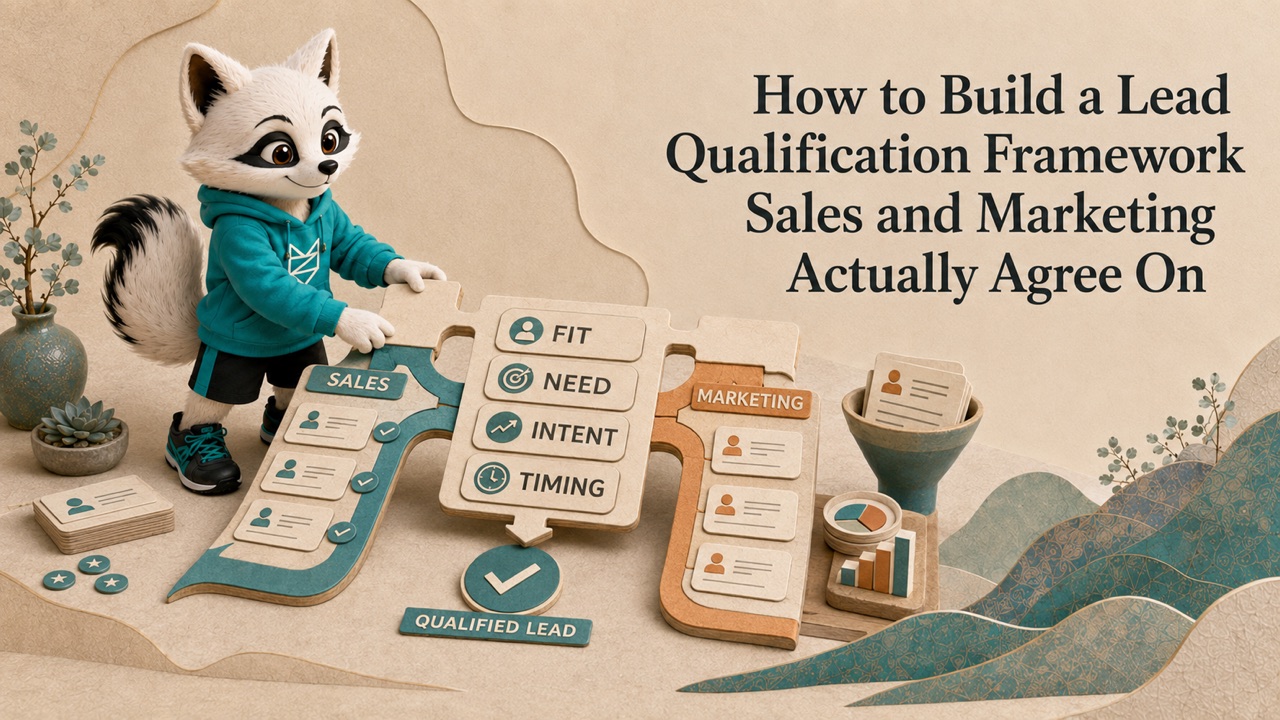
A shared qualification framework fixes the recurring "these leads are bad" versus "sales isn't following up" argument by replacing gut feel with written, observable criteria for what counts as an MQL and what counts as an SQL, tied to a response-time SLA both teams have actually agreed to. Most of this conflict isn't a lead-quality problem. It's a definition problem that never got written down.
This is the fifth piece in our acquisition-economics series. It builds directly on CPL vs CPQL vs CAC, which introduced CPQL as the metric that depends entirely on having a real qualification definition, and on the weekly scorecard, which flags any channel with an SQL rate below roughly 10%. This piece is where that definition actually gets built.
Why the fight keeps happening
The reporting gap and the sales-marketing dispute usually have the same underlying cause: nobody agreed, in writing, what "qualified" means before the leads started arriving.
Without a written definition, marketing optimises toward whatever the ad platform calls a conversion, sales rejects whatever doesn't smell right on the first call, and both sides are technically right from where they're standing. Marketing hit its lead target. Sales spent its time on leads that were never going to close. Neither number was wrong. The definition was just never shared.
MQL and SQL, defined with observable criteria
The fix isn't a stricter form. It's a written, two-stage definition that both teams sign off on before the next campaign launches, not after the first batch of complaints.
MQL (Marketing Qualified Lead) — fit-based, checkable from data marketing already has:
- Matches defined firmographic criteria (company size, industry, role/seniority)
- Took an action that signals more than passive interest (a demo request, a pricing page visit, a completed content download tied to a buying-stage topic, not just a newsletter signup)
- Isn't on a disqualification list (competitor, existing customer, wrong geography)
SQL (Sales Qualified Lead) — validated on a real conversation, not inferred:
- Confirmed budget authority or a credible path to it
- A stated need that maps to what's actually being sold, not a tangential interest
- A timeline that makes the deal realistic within a defined window (most teams use 90 days, adjusted for typical sales-cycle length)
- A named next step both parties agreed to on the call
This is a lightweight BANT structure (Budget, Authority, Need, Timeline), and the specific model matters less than the fact that it's written down, scored the same way every time, and reviewed quarterly rather than left to interpretation. A framework everyone follows loosely is worse than a simpler one everyone follows exactly.
The SLA that makes the definition mean something
A definition without a response commitment attached to it doesn't hold up under pressure. The SLA needs two halves:
Marketing's commitment: every lead passed to sales meets the written MQL criteria, no exceptions made to hit a volume target. If a channel is generating volume that doesn't meet the bar, that's a targeting problem to fix upstream (see the diagnostic guide), not something to pass through and let sales catch.
Sales' commitment: every MQL gets a genuine response within an agreed window, and every rejection gets logged against a specific criterion, not a vague "not a fit." Response speed matters more than most SLAs account for: the original Lead Response Management study found that the odds of qualifying a web lead fell 21-fold when first contact slipped from five minutes to thirty. An SLA with no time commitment in it is missing one of the variables most likely to determine whether a genuinely good lead actually converts.
Logged rejection reasons are what turn this from a policy into a feedback loop. "Not a fit" tells marketing nothing. "Wrong company size" or "no budget authority confirmed" tells marketing exactly which criterion to tighten.
Building the feedback loop
This only works if it's structural, not a Slack message when someone's annoyed:
1. A rejection reason field in the CRM, mandatory on every SQL-to-MQL bounce-back. Free text is better than nothing, but a dropdown against the written criteria above is better than free text, because it's reportable.
2. A monthly review of rejection reasons by channel and campaign. If one channel is producing a disproportionate share of "no budget authority" rejections, that's a targeting fix, not a sales-effort problem, and the monthly review is where that becomes visible rather than anecdotal.
3. Criteria revisited quarterly, not left static. What counted as a qualified lead at seed stage rarely holds at scale, and a framework nobody's allowed to update becomes a framework nobody actually follows.
What not to do
Don't let sales reject a lead without logging why. An unlogged rejection is a data point marketing can never act on, and it's the single most common reason this feedback loop quietly stops functioning within a few months of being set up.
Don't build the criteria in a room without sales in it. A qualification framework marketing designs alone and hands to sales as a fait accompli gets followed for about two weeks.
Don't treat the SLA as a one-time document. Response-time commitments erode fast without a monthly check against actual response-time data — track it, don't assume it's being honoured.
Where Zenko fits
A lot of qualification disputes exist because the "signal" a lead is scored on is a form fill, which is a cheap, easily gamed action that tells you someone was willing to type an email address in exchange for something, and not much else.
Zenko's reward-based model changes what the qualifying signal actually is. When the action that earns the reward is a completed learning module, a verified real-world action, or genuine engagement with a campaign rather than a discount-driven form fill, the intent signal arriving at sales is already stronger before any manual qualification happens. That doesn't remove the need for a written MQL/SQL framework — it still matters, and the criteria above still apply — but it does mean fewer leads sit in the disputed middle ground where marketing says "they converted" and sales says "they were never real."
FAQ
What's the difference between an MQL and an SQL? An MQL meets fit criteria marketing can check from data already available: firmographics, an action that signals real interest, no disqualifiers. An SQL has been validated on an actual conversation against budget, authority, need and timeline. MQL is marketing's call. SQL is sales' call, made on evidence, not instinct.
How do we stop sales from rejecting leads unfairly? Make rejection reasons mandatory and tied to the written criteria, not free text or a verbal aside. If rejections cluster around a specific criterion, that's a signal to review targeting on that channel, not a reason to assume sales is being difficult.
How often should qualification criteria be updated? Quarterly is a reasonable default. Criteria that made sense at an earlier stage of the business — a smaller ideal customer profile, a shorter sales cycle, a different price point — often stop matching reality without anyone deciding to change them.
Does a qualification framework slow down lead flow? It changes the composition of lead flow, not necessarily the volume. A tighter MQL definition often reduces raw lead count while increasing SQL rate, which is usually a net improvement in CPQL and CAC even though the top-line lead number looks smaller.
This is the fifth piece in our acquisition-economics series. Read the earlier pieces: the CPL playbook, CPL vs CPQL vs CAC, the high-CPL diagnostic guide, and the weekly scorecard template. Then continue to the landing-page friction guide or open the complete playbook.