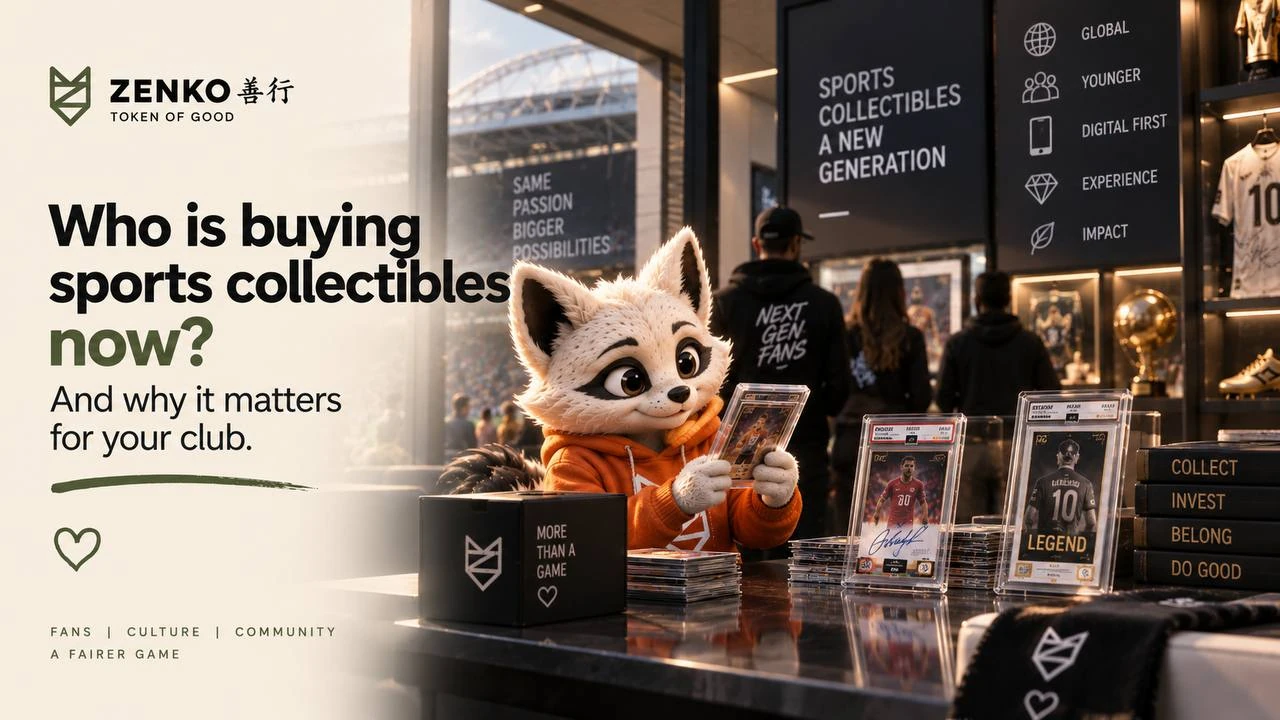
The sports collectibles buyer has changed. Across 2023 to 2026 industry syntheses, 42 to 45% of US sports collectors are aged 18 to 34, women make up about 28% of memorabilia buyers, up from 18% in 2019, and 32% of collectors aged 18 to 24 own digital sports collectibles against 5% of over-55s. Treat the exact figures as directional; the direction is clear. This is the audience clubs are losing to platforms.
How big is the market?
Estimates vary by an order of magnitude depending on whether the firm counts sports cards only, or adds Pokémon and other trading card games, or adds fan merchandise on top. Grand View Research sized sports trading cards at $13.5bn in 2025, heading for $24.7bn by 2033. Zion Market Research had $11.52bn for 2024, Verified Market Research $12.62bn. Fanatics' own profile on Sacra refers to a $25bn trading card industry. For memorabilia and cards together, Market Decipher's December 2024 report is the aggressive case: about $33.6bn in 2024 rising to $271.2bn by 2034 at 22.1% a year. A commonly cited mid-range synthesis runs from about $33.6bn to $60bn by 2030 at 7.5%. Pick a firm, state the scope, and expect the next report to disagree.
The legitimacy markers
Whatever the total, the top of the market has institutionalised. Babe Ruth's 1932 jersey sold for $24.12m at Heritage Auctions in August 2024, the most expensive piece of sports memorabilia ever sold, nearly double the previous record. The collector who bought it in 2005 for $940,000 realised a thirteen-fold return. Other benchmarks: the 1952 Topps Mickey Mantle at $12.6m in 2022, a Kobe Bryant and Michael Jordan dual logoman card at $12.9m in 2025, Jordan's 1998 Finals jersey at $10.1m, Maradona's Hand of God shirt at $9.3m. Heritage posted total sales of $1.867bn in 2024, its fourth consecutive record year, with the sports division alone above $200m.
Underneath the headlines sits the infrastructure that makes it work: grading and authentication by PSA, Beckett and SGC, which is what turns a card into something a stranger will pay for. Fanatics' collectibles business grew from $368m of sales in 2020 to $1.6bn in 2024 on that foundation.
Who is buying
The demographic picture comes mostly from secondary aggregators, so we treat it as directional and say so. With that caveat: 42 to 45% of US sports collectors are aged 18 to 34. Millennials are the largest cohort, at 41 to 60% depending on the study. Gen Z is the fastest-growing, with a cited 28% annual growth in collectibles spending since 2020. The average US sports card collector spends about $1,200 to $1,250 a year. Women are about 28% of global memorabilia buyers, up from 18% in 2019. Among collectors aged 18 to 24, 32% own digital sports collectibles; among over-55s, 5%. Art Basel and UBS survey data adds that younger high-net-worth individuals are far more active in non-art collectibles, sports assets included, than older generations. During the pandemic, Team Whistle found 85% of its 13 to 39 audience interested in cards.
A word on collectibles as an investment
The short version: blue-chip graded cards have outperformed the S&P 500 over long horizons (the PWCC Top 500 index returned 165% over the ten years to 2018 against 71% for the S&P, per Forbes), the tier below that only matched the index, returns are cyclical and illiquid, and the average card is worth very little as an investment. Knight Frank's broader luxury collectibles index fell 3.3% in 2024. None of that applies to what we make. A Zenko collectible is earned by doing something, is tied to an outcome, and is never described or designed as an investment Fan tokens fell 96%. What actually survived the digital collectibles crash.
Why it matters for a club
The profile above describes the supporter a club is least likely to have a name for: young, on their phone, following on someone else's platform, already comfortable with digital ownership. The lowest-risk way to meet that supporter is a free, earned digital collectible attached to something they already do, whether that is buying the shirt Fanatics made $8.1bn. The league got 6 to 8% of the shirt or playing a prediction round. It costs the fan nothing, it gives the club a name and a contact, and it is the first step in the ninety-day sequence A 90-day plan to give your club a fan revenue line.
FAQ
How big is the sports collectibles market? Sports trading cards alone were about $13.5bn in 2025 (Grand View Research). Memorabilia and cards together range from about $33.6bn (Market Decipher, 2024) to higher figures depending on scope.
Who collects sports cards? Increasingly younger buyers: 42 to 45% of US sports collectors are 18 to 34, with Gen Z the fastest-growing group and women about 28% of memorabilia buyers (2023 to 2026 syntheses, directional).
Are sports collectibles a good investment? Blue-chip graded cards have outperformed equities over long periods, but the outperformance is concentrated at the very top, cyclical and illiquid, and the average card is worth little as an investment. This is context, not advice.
What is a digital collectible in football? A fixed-supply digital item tied to a club, a moment or a purchase. The versions that have held value are earned, useful and verifiable.