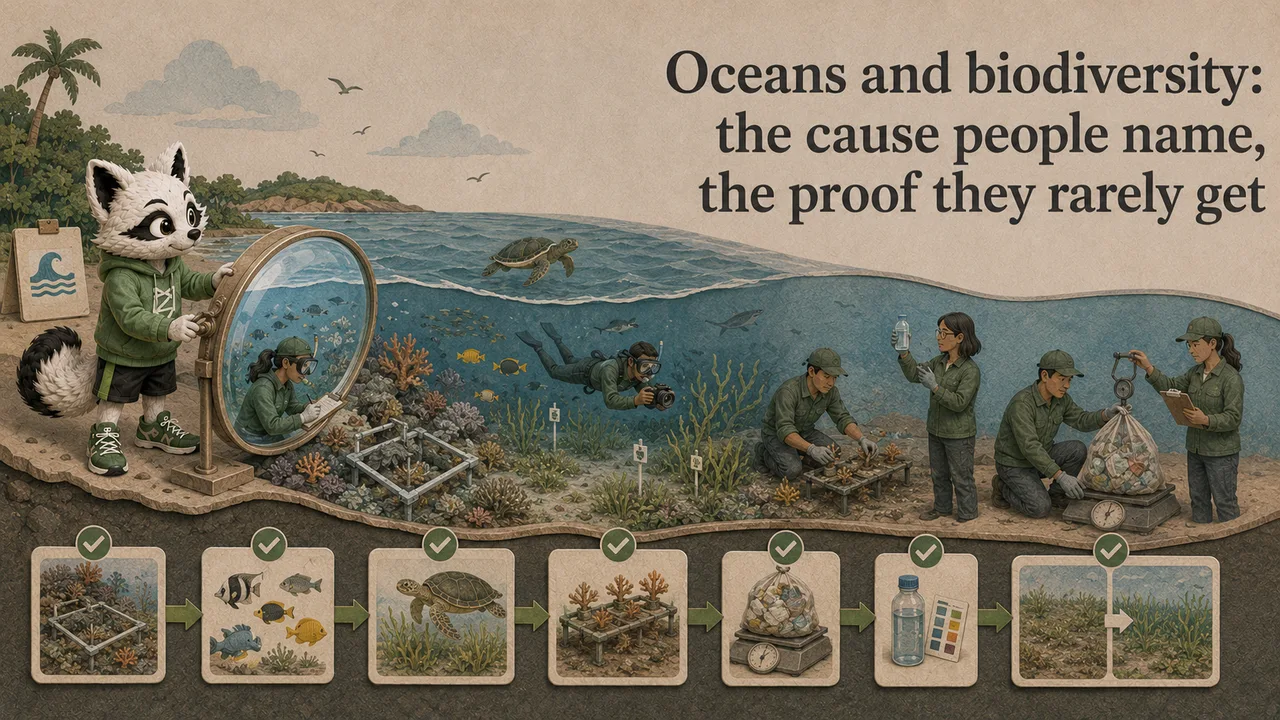
2026 giving data on a cause people name, and the proof they rarely get, for brands still briefing oceans as if a film were a result.
People name the ocean. They rarely fund it. They almost never get a result they can count.
A brand that briefs “biodiversity and ocean health” as if the audience already chose it, and as if a coastline film were proof, is selling a name. The 2026 giving maps do not treat oceans as a mass gift. The official UK claim tests do not treat a film as a result.
This page is the last of the environment trio. It owns oceans and biodiversity as a named cause people brief, and the proof they rarely get. A tree is not this product; that cut lives on trees, rewilding, and what people think they are funding. A carbon credit is not this product; that cut lives on carbon offsetting without the greenwash script. Maps, mechanism, children, local-versus-global and education live earlier. This page does not reprint them.
This journal is published by Zenko Protocol, an engagement-and-impact platform. Not a product tour. Named 2024-2026 sources only. The site’s only confirmed public act is still 2,000 meals from the MK Dons Shop for Good programme, a food-poverty programme, not an ocean result.
TL;DR: People name oceans, biodiversity, “the planet.” They rarely fund them as a distinct gift, and they almost never get a visible, countable proof. Concern is not a gift: UNDP 2024, 80% want stronger government climate action; CAF UK Giving 2026, environment £658m; BlueState April 2026, environment and climate about 6% of UK donors; Giving USA 2026, environment and animals $24.57bn, 4%. Combined US category. Not an oceans ranking. UK animals took £1.00bn (CAF) and 23% of BlueState donors, a different cause, and not a lane on this site. Official UK tests already refuse an unsubstantiated ocean claim. The CMA Green Claims Code requires claims to be truthful, clear, complete and substantiated. The ASA (2 April 2025) upheld against OceanSaver’s “plastic-free,” “don’t harm the sea,” and “2 million pieces of plastic saved from our ocean” lines because unit sales were not evidence that plastic had been kept out of the sea. This site names Second Life on the biodiversity and ocean-health lane (20 August 2026 capture). Name only. No confirmed ocean or biodiversity act. Partner evidence of physical impact is not an on-chain participation record. 2,000 meals here are food poverty, not an ocean result. Not a trees essay. Not a carbon essay.
The conventional brief still names the ocean as if that were a gift
Most purpose work treats “oceans and biodiversity” as a cause everyone already funds, and a coastline film as the proof. The giving maps do not agree. The claim tests do not either.
The named-cause brief is easy to approve. Logo-fit. A drone shot of a reef. A “save the ocean” line that sounds like leadership in the room that commissioned it. None of those tests ask whether the audience funds this lane, or what physical act, if any, exists.
How people choose lives on how people choose a cause. This page stays on one lane and two missing things: a distinct gift, and a countable proof.
People will name the ocean in a workshop. They will name biodiversity on a slide. They will name “the planet” when they do not want to pick a product. Naming is not funding. A name is not a result.
Concern is not an ocean donation
Most people want stronger climate action. Most of them do not give their money to environment or climate causes. An ocean brief that opens on concern is reading a poll, not a donor file, and it is not reading an oceans file at all.
The UNDP / University of Oxford Peoples’ Climate Vote 2024 (20 June 2024; more than 73,000 people, 77 countries) found 80% want their country to strengthen its climate commitments. That is civic concern about government. It is not a donation, and it is not “80% donate to oceans.”
The gift, in the UK, is small, and it is not an oceans line. Environment took £658m in 2025 (CAF UK Giving Report 2026, 16 March 2026; YouGov; N=12,913; Figure 11, money table N=3,936). BlueState (April 2026; fieldwork 30 January-2 February 2026; N=2,136) puts environment and climate at about 6% of donors, against 7% in the 2024 column. In the US, environment and animals together took $24.57bn in 2025, 4% of $617.20bn (Giving USA 2026, 23 June 2026; year 2025). Combined category. Small base. This page does not split oceans out of that pot. No primary source fetched for this draft does.
The environment-lane gap lives on spoke 5. The carbon version lives on spoke 6. The three-map rule lives on why people support the causes they support. This page holds one fact: oceans and biodiversity are not a global top donation cause.
Animals are a cause people fund. Oceans are not that cause
UK donors do fund animals. They do not, on the published tables, fund oceans as a distinct gift. Collapsing the two is how a brief steals a popular cause the marketplace does not even list.
CAF UK Giving 2026 Figure 11 puts animal welfare at £1.00bn, ahead of environment at £658m. BlueState puts animal welfare at 23% of donors, against 6% for environment and climate.
Animals are not a lane on the five cause lanes people can choose. Homepage copy names “Biodiversity & ocean health.” It does not name animals, WWF, Ocean Conservancy, or a second ocean NGO. Do not invent that marketplace. Do not write “people love animals, so they fund ocean health.” They fund animals. That is a different cause.
Giving USA’s $24.57bn is environment and animals together. Combined. This page does not pull a marine line out of that total.
A named ocean cause is not a countable result
The second missing thing is proof. People will accept a name. They rarely get a number that survives a claim test.
The CMA Green Claims Code is the consumer-law floor. Claims must be truthful and accurate, clear, complete, and substantiated. They must consider the full life cycle. The CMA’s wording takes in air, water or soil, and treats sustainability claims, including biodiversity, as in the same family. Broad lines such as “green,” “eco-friendly,” or “save the planet” are the ones most likely to over-claim.
That is not a carbon-credit test. Additionality and permanence live on spoke 6. This page stays on water and wildlife-in-the-water: a plastic number, a species line, a reef film sold as a result.
The Advertising Standards Authority has already applied that discipline to an ocean claim. On 2 April 2025 it upheld four complaints against OceanSaver Ltd. “Plastic-free” and “zero microplastics” were not substantiated for the products as sold. “So you don’t harm the sea” was not substantiated. “Biodegradable film” and “fully biodegrade” were not substantiated for normal use. The line “over 2 million pieces of plastic and 11,000 litres of harmful chemicals saved from our Ocean so far” was not substantiated either. OceanSaver offered unit sales, plus a WWF page that 80% of ocean plastic originates on land. Sales were not evidence the claimed plastic had been kept out of the sea.
A brand that briefs a plastic-kilogram ledger, a species count, or a “saved the ocean” film without that evidence is writing the same script. This page does not invent a junk percentage for ocean credits or plastic offsets. If a primary page cannot be fetched, the number is omitted. The SC Johnson “ocean plastic” story that circulates in secondary round-ups is omitted here for that reason: no official ASA primary page was fetched.
This site names a lane and a partner. It does not name an ocean act
/causes/ lists biodiversity and ocean health with Second
Life. That is an on-page name, as of the 20 August 2026 capture. A live
fetch of /causes/ on 21 August 2026 returned the page title
and a collapsed body. The partner name and any descriptive line were not
visible. This page does not invent an on-page sentence. The 20 August
capture recorded the name only. No extra tagline was recorded.
Second Life is a name. It is not a contract audit. It is not a verified plastic, reef, or species inventory through this marketplace. Do not invent project results, vintages, prices, volumes, or a second ocean NGO as a partner. Do not add WWF, Ocean Conservancy, or Surfers Against Sewage. Homepage copy names the lane “Biodiversity & ocean health.” It does not invent a new marketplace.
Partner evidence of physical impact is not an on-chain participation
record. Collapsing them is how “on-chain verified oceans” gets written
on top of a name. Do not write that. Other claims that may sit on
/causes/ (retired carbon units, GPS-tagged trees) are not
ocean proof. Do not borrow them.
The only confirmed public act on this site is still the 2,000-meal programme. Food poverty. Not an ocean result. Already linked above. Do not restage it, and do not treat meals as biodiversity.
See the five cause lanes people can choose. The honest answer, today, is a named lane and a named partner. Not a confirmed act.
What a brand should do with this
Read the name the brief is actually using. Do not invent a gift, or a count, to fill a missing result.
A short checklist. Not a product demo. Not a second copy of how people choose a cause.
- Do not brief oceans as a mass gift. Environment is £658m and about 6% of UK donors. US environment and animals together are 4% of giving. Oceans are not split out of those pots. This is not a top-supported giving cause.
- Do not treat UK animals money as ocean money. £1.00bn, 23% of BlueState donors, and not a lane on this site.
- Do not sell a coastline film as a countable result. The CMA already names the tests. The ASA already upheld an ocean-plastic count that was only sales.
- Do not sell oceans as trees, or as carbon. Those products live on spoke 5 and spoke 6. One sentence. Then stop.
- Let the participant choose among the five cause lanes people can choose. This lane has a named on-page partner and no confirmed act. Do not invent a kilogram, a reef, or a species count. Do not add a sixth lane.
The brief is working if the team can say what was named, what was funded, and what physical act, if any, exists. That is not a cost-per-lead, and it is not an ocean dashboard.
A sports organisation with a local, checkable act on another lane should not swap it for a coastline film. Geography lives on local vs global.
FAQ
Do people donate to oceans?
Not as a distinct, mass gift in the 2026 tables this page can cite. Environment is £658m in the UK and about 6% of BlueState donors. US environment and animals together are 4% of giving. This page does not invent an oceans-only ranking, and it does not write “most people donate to oceans.”
Is wanting the ocean protected the same as funding it?
No. UNDP 80% is government climate action. BlueState 6% is a gift to environment and climate. Different surveys. Different questions. Neither is an oceans-only file.
Are UK animal donations ocean donations?
No. CAF puts animal welfare at £1.00bn. BlueState puts it at 23% of
donors. That is a cause people actually fund. It is not ocean health,
and it is not on /causes/.
What counts as proof on this lane?
A physical act a participant can name, with evidence that survives the CMA tests and, if advertised, the ASA’s substantiation rules. Unit sales are not plastic saved from the sea. A film is not a species count. Partner evidence of physical impact is not an on-chain participation record.
What has this site actually delivered on oceans?
A named on-page partner (Second Life, 20 August 2026 capture, name only). Not a confirmed ocean or biodiversity act. The only confirmed public act is 2,000 meals: food poverty, not an ocean result.
People name the ocean. Catch the brief up.
A named-cause film asks people to fund a slogan. Most of them fund something else. Almost none of them are shown a count that would survive a claim test.
- People name oceans and biodiversity. They rarely fund them as a distinct gift. Environment is a small pot. Oceans are not split out of it.
- UK animals money is real, and it is a different cause. Do not steal it for this lane.
- A name is not a result. CMA and the ASA already refuse an unsubstantiated ocean claim.
- This lane names Second Life. It does not name an ocean act. Meals on this site are food poverty, not biodiversity.
See the five cause lanes people can choose, or use Talk to us in the site navigation if the next step is a conversation with Zenko Protocol.
Continue through the Causes People Choose series
- Why people support the causes they support (and why brands still pick the wrong one)
- How people choose a cause
- Food poverty and feeding children
- Local vs global: why a shirt in Milton Keynes beat a world-saving slogan
- Why education and schools keep getting support
- Trees, rewilding, and what people think they are funding
- Carbon offsetting without the greenwash script
- Oceans and biodiversity: the cause people name, the proof they rarely get