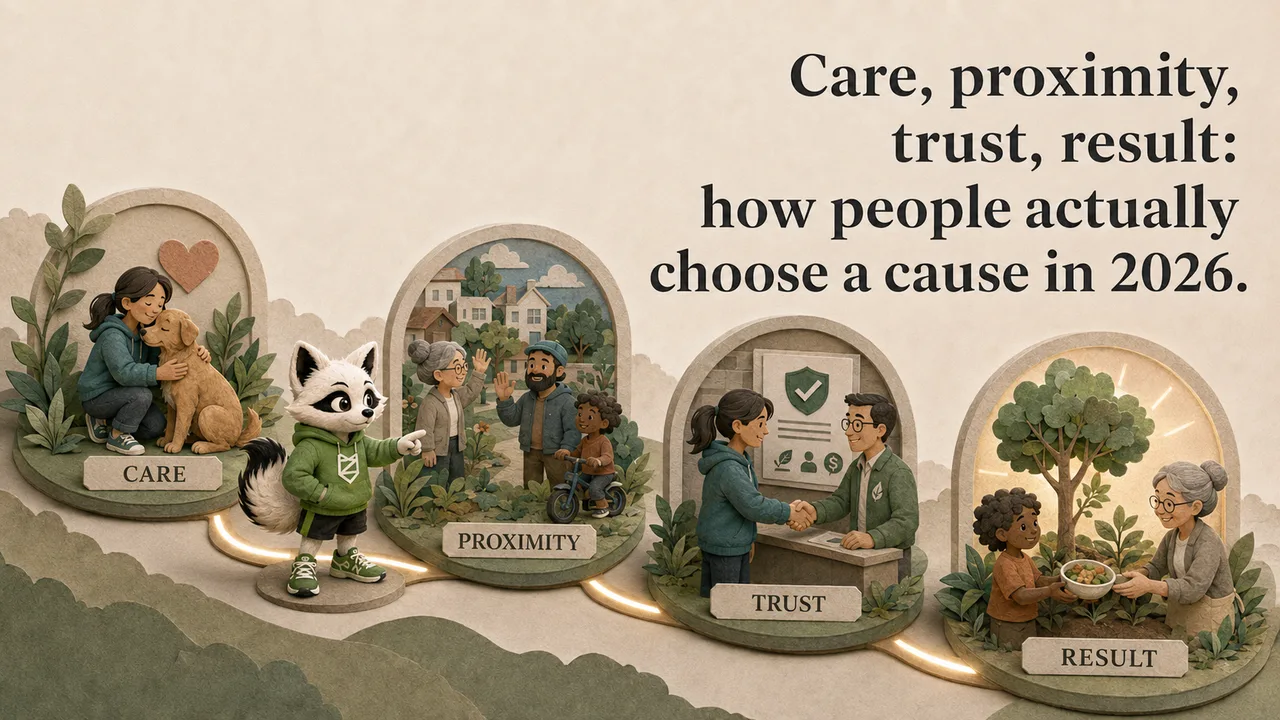
Care, proximity, trust, result: how people actually choose a cause in 2026. Why a brand that picks our cause from the boardroom still gets it wrong.
People already chose. The brand that writes "our cause" on the purpose brief is late.
Purpose incentives fail when the brand assigns a cause the audience will not carry. The assignment is usually logo-fit, an ESG slide, or a guilt film. Then the room wonders why no one talks about it.
This is the mechanism, not the map. People choose by care, proximity, trust, and a visible result. The 2026 maps live on why people support the causes they support. This page does not reprint them.
This journal is published by Zenko Protocol, an engagement-and-impact platform. Not a product tour. Named 2025-2026 sources only. One confirmed public programme: 2,000 meals from the MK Dons Shop for Good programme.
TL;DR: People already have a cause. Brands still write "our cause" on the brief. CAF's World Giving Report finds 65% give because they care / want to make a difference. In the UK, 78% of donors named an emotional reason (58% "I care about the cause"). People say they would be more likely to give if they knew how the money is spent (36%) and what impact it might have (35%). Local charities (56%) beat multi-country ones (22%); seeing local impact is associated with twice the chance of donating and three times the share of income given. UK giving participation is 55% (was 69% in 2016); affordability is a named barrier. This spoke explains the mechanism and points to the five cause lanes people can choose.
The conventional brief still starts with "our cause"
Most purpose work treats the cause as a brand asset to be selected, then sold. People treat a cause as a commitment they already made.
That view is popular because it is easy to approve: one campaign line, logo-fit, an ESG slide, a climate film that looks like leadership in the room that commissioned it. None of those tests ask whether the audience will carry the cause.
The habit has a second source. Charity fundraising pages tell charities how to ask. CAF's align-the-ask guidance is useful if you already hold a donor file. 2026 vendor posts (Bloomerang, Zeffy) do the same job. They are the wrong brief for a brand about to assign a cause.
CAF America, from a dual-taxpayer study, found connection to a cause is near-universal among the donors it asked: 97% UK / 98% US. Social pressure is common and rarely primary (9% UK / 22% US). Convenience and a clear impact story beat guilt. Not charity driven by guilt. Not the 2026 World Giving Report, and still the cleanest published split on whether shame does the work. It does not.
The 2025 World Giving Report (21 July 2025; Focaldata, 6-31 January 2025; 50,000+ people, 101 countries) put the same point in mass-behaviour terms. 65% donate to make a difference to a cause they care about. That is the starting point, not the ask.
Care is the first filter - not the brand's logo
The first screen is emotional and specific. People give to a cause they already care about. They do not give because the brand cares.
UK donors say it tighter. In the CAF UK Giving Report 2026 (16 March 2026; YouGov Plc; N=12,913; donors N=7,247), Figure 8 finds 78% of donors named at least one emotional reason. 58% said "I care about the cause". Also on that figure: 36% "I trust the organisations I donate to" - donor trust, not the World Giving Report figure on knowing how money is spent.
The Charity Commission / BMG Public trust in charities 2026 (N=4,681, England and Wales, January 2026) is a belief check, not a marketplace map. Among money-donors, 54% selected "I believe in the cause that this charity supports"; 45% selected "the charity makes a positive difference".
Beth Breeze's How donors choose charities (2010 / 2013) framed this earlier: taste beats abstract "need". The 2025-26 numbers update that frame.
Health and animals score high in UK money and consideration. Religion is the largest global named cause in the World Giving Report 2026 (31%). Context only. Not new lanes on the five cause lanes people can choose.
Proximity decides which cause people will carry
After care, people fund what they can see nearby. A multi-country slogan loses to a local, checkable act.
The World Giving Report 2026 Donor Insights (PR 3 June 2026; 60,000+ people, 105 countries) finds people are much more likely to support local charities (56%) than those working across many countries (22%). People who recognise positive local charity impact are twice as likely to donate, and three times more generous as a share of income. They are also twice as likely to get involved; that is not the donate / income pair. The 2x / 3x is a global association between seeing local charity impact and giving more. The planned spoke Local vs global: why a shirt in Milton Keynes beat a world-saving slogan holds the separate UK-only local pair.
Belonging is separate: countries where more than 80% feel strong local belonging give 1.7% of income, against 0.6% where belonging is low.
The only confirmed public programme behind this site is local in that
sense. MK Dons Shop for Good, with Surplus to Purpose, funded 2,000
meals of fresh fruit and vegetables. The club's 17 July 2026 release
is the primary record (MK
Dons). llms.txt (reviewed 22 July 2026) names four
Milton Keynes hubs; homepage case-study copy (captured 20 August 2026)
says three schools in the Milton Keynes City area. The sources disagree.
This page does not pick a number. That 2,000-meal figure is partner
evidence of a physical act, not an on-chain participation record. Local
proof versus a global slogan belongs on the planned spoke Local vs
global: why a shirt in Milton Keynes beat a world-saving
slogan.
Trust and a visible result unlock the next gift
Care gets someone to the door. Knowing how the money is spent, and seeing a result, is what people say would make them more likely to give. Affordability is a real, named barrier. A purpose campaign does not remove it.
The 2025 World Giving Report press wording: people said they would be more likely to donate if they had more money (45%), knew how their money would be spent (36%), and knew the impact the charity might have (35%). Those 36% and 35% figures are people, not a non-donor subset.
UK Giving 2026 finds 55% of adults donated or sponsored in 2025, against 69% in 2016. Affordability is the main reason people do not donate: 49% of non-donors (N=5,666); one in five people in the UK.
Trust is the spend-and-result test, not a warmer film. In Public trust in charities 2026, the top selected driver of whether to trust a charity is "most of the money raised is spent directly on the causes the charity supports" (55%, from 53% in 2025). "Makes a real difference" rose to 51%.
The unlock is proof of spend and result. Convenience and a clear impact story beat guilt. A participation record is not the meal. Partner evidence of a physical act and an on-chain record that someone took part are different facts.
Why "we picked our cause" fails
The wrong cause is the one the audience will not recognise as theirs. Usually it was chosen for logo-fit, an ESG slide, or guilt, not for care, locality, and a checkable act.
Five commercial reasons. Not a product demo.
- It asks people to abandon a cause they already carry. Connection to a cause is near-universal among donors (CAF America: 97% UK / 98% US).
- It usually lands on a climate or logo-fit lane the mass-giving maps do not lead with. That gap lives on why people support the causes they support.
- It substitutes a slogan for a nearby, visible result. The opposite of the 56% / 22% split and the 2x / 3x finding in the World Giving Report 2026.
- It leans on social pressure or guilt. Common, rarely primary: 9% UK / 22% US (CAF America).
- In a market where only 55% of UK adults still give, an unchosen cause is an easy no. Affordability is the named barrier (UK Giving 2026).
Low carry is a selection problem. If the audience cannot name the cause as theirs, and cannot name the physical act, the brief already failed.
Five lanes people can actually choose here
This site's cause marketplace has five named lanes. The participant chooses among them. That is on-page product copy, not a list of live funded programmes.
Partners below are the names on /causes/ as of the 20
August 2026 site capture (lane labels and Surplus to Purpose re-checked
21 August 2026).
- Feed children in food poverty. Surplus to Purpose. UK. US cause partner pending. Only confirmed public proof: MK Dons Shop for Good, 2,000 meals. Highest evidence fit with care, proximity, and a visible result.
- Reforestation and rewilding. Eden Reforestation. A lane a participant may choose. Not a mass-donation leader. No invented tree counts.
- Carbon offsetting. Rimba Raya Biodiversity Reserve. No invented tonnes. A pledge is not evidence.
- Biodiversity and ocean health. Second Life. A cause people name. Proof they rarely get. Not a global top donation cause.
- Education and schools. "Various delivery partners." No named school partner. No invented attainment outcome.
See the five cause lanes people can choose. Later spokes hold the depth.
What to do instead
Start from the cause the audience already carries, show a nearby physical act, and let the participant choose among the five live lanes.
- Read the three maps on why people support the causes they support before the purpose deck is written. This page is the mechanism. The pillar is the atlas.
- Prefer visible local proof over a multi-country slogan. Then read the planned spoke Local vs global: why a shirt in Milton Keynes beat a world-saving slogan.
- Show how money becomes a physical act. Partner evidence of impact and an on-chain participation record are different facts.
- Let the participant choose among the five live lanes. Do not invent a sixth.
- One confirmed example beats a deck of unfunded outcomes. The 2,000-meal programme is the public proof. Hub counts still disagree.
The brief is working if the audience recognises the cause as theirs
and can name the physical act. Affordability remains a named barrier (UK
Giving 2026). Health, animals and religion are large in the data and
not on /causes/. Climate concern is not climate money: that
argument lives on the pillar.
FAQ
How do people choose a cause?
Care first, then proximity, then trust that the money becomes a visible result. 65% donate to make a difference to a cause they care about (World Giving Report 2025). 78% of UK donors named an emotional reason; 58% "I care about the cause" (UK Giving 2026, Figure 8).
Why does a brand that picks the cause still fail?
Because the audience already chose. Assigning a logo-fit or ESG-favourite lane asks them to carry someone else's commitment. Local 56% versus multi-country 22% (World Giving Report 2026).
What would make people more likely to give?
People say: more money (45%), knowing how money is spent (36%), knowing the impact (35%). That is the World Giving Report 2025 press wording, cited as people. Affordability is the main UK reason for not giving: 49% of non-donors, and one in five people. A clearer film does not answer that.
What should a brand do first?
Do not write "our cause" before reading why people support the causes they support. Pick a lane the audience already carries, show a physical act, and point people to the five cause lanes people can choose. Do not add a sixth.
People already chose. Catch the brief up.
People already have a cause. The mistake is substituting the boardroom for a choice they already made.
- The choice is already made: care, then proximity, then trust, then a visible result.
- "We picked our cause" fails because it asks people to carry someone else's commitment.
- Five lanes are live. One programme is confirmed: 2,000 meals. Partner evidence of that act is not an on-chain record.
- Affordability is a real barrier, not a copy problem.
See the five cause lanes people can choose, or use Talk to us in the site navigation if the next step is a conversation with Zenko Protocol.
Continue through the Causes People Choose series
- Why people support the causes they support (and why brands still pick the wrong one)
- How people choose a cause
- Food poverty and feeding children
- Local vs global: why a shirt in Milton Keynes beat a world-saving slogan
- Why education and schools keep getting support
- Trees, rewilding, and what people think they are funding
- Carbon offsetting without the greenwash script
- Oceans and biodiversity: the cause people name, the proof they rarely get