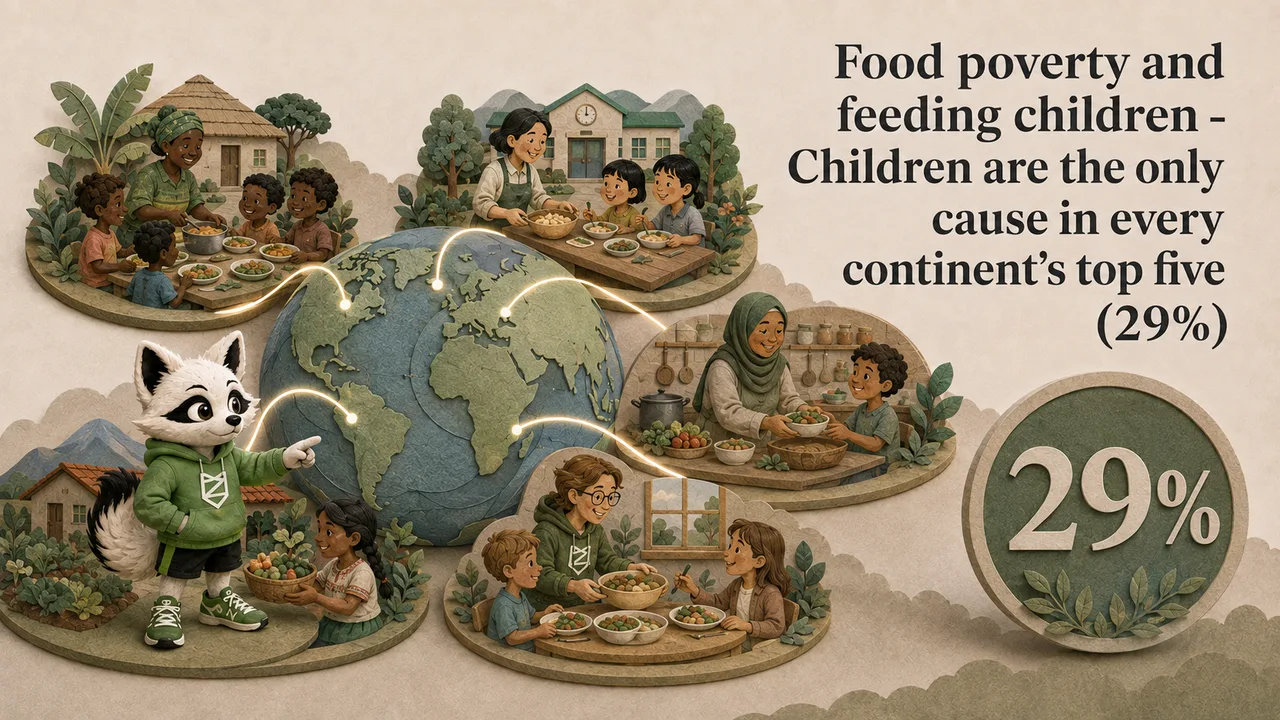
2026 giving data on the only globally portable mass cause — and the only one on this site with a checkable meal count.
This is the only cause that travels. It is also the only one on this site with a confirmed public act.
Children and young people are supported by 29% of people worldwide, and they are the only cause in every continent’s top five, two years running. Poverty relief sits next to them, also at 29%. In the UK, children take £1.49bn, a quarter of all donors, and the most volunteer time. Food banks take a further £610m.
A brand that treats feeding children as a local extra, or as a guilt film, is reading the wrong map.
This page is the data on one lane. The 2026 maps live on why people support the causes they support. The choice mechanism lives on how people choose a cause. This page does not reprint either.
This journal is published by Zenko Protocol, an engagement-and-impact platform. Not a product tour. Named 2025–2026 sources only. One confirmed public programme: 2,000 meals from the MK Dons Shop for Good programme.
TL;DR: Feeding children is the only globally portable mass cause, and the only lane on this site with a confirmed public act. CAF’s World Giving Report puts children and young people at 29% of people, the only cause in every continent’s top five two years running; poverty relief sits next to them at 29%. In the UK, children take £1.49bn, 25% of donors, and 22% of volunteers — the most popular volunteer cause. Food banks take a further £610m. The confirmed count is 2,000 meals from MK Dons Shop for Good × Surplus to Purpose. This spoke is the data on that lane. It is not a guilt appeal, not a hunger-policy paper, and not a restage of the shirt-sale post.
Four numbers, three units, one lane
The data on this lane fits on one card. The units are not the same. Do not flatten them into a world ranking.
- 29% of people, every continent. Children and young people are the only cause in every continent’s top five, two years running (CAF World Giving Report 2025; restated as every-continent top five in CAF’s 2026 “Why do we give” commentary).
- £1.49bn, 25% of donors, 22% of volunteers. UK children money, donor share, and the most popular volunteer cause (CAF UK Giving Report 2026, Figure 11).
- £610m to food banks. A separate UK pot in the same table. Not the same as “children.” Not the same as “poverty relief” (£367m).
- 2,000 meals. The only confirmed public act on this site.
This is not a proprietary survey and not a first-party dashboard. It
is a reading of the 2025 and 2026 World Giving Reports and UK Giving
2026, held against the one /causes/ lane that already has a
checkable physical act. CAF does not print a cause labelled “food
poverty.” Children, poverty relief, and food banks are three labelled
pots. This page holds them together because that is the lane the
marketplace already named.
Children are the only cause that travels
Children and young people are supported by 29% of people worldwide, and they are the only cause in every continent’s top five two years running.
The 2025 World Giving Report (21 July 2025; Focaldata, 6–31 January 2025; more than 50,000 people, 101 countries) put it in one line: the most popular cause is children and young people, supported by 29% of people, and a top cause in every continent.
A year later the named-cause list has company, not a reversal. The World Giving Report 2026 (PR 3 June 2026; more than 60,000 people, 105 countries; behaviour in 2025) finds religious causes supported by 31% of people. Children and young people, and poverty relief, are each supported by 29%. CAF’s 2026 commentary restates the geography: across every continent, children feature among the top five most supported causes.
That is the portable number. A US brief that leads on education is reading US dollars. A UK brief that leads on health is reading UK pounds. A climate brief is reading concern. Children is the one mass cause that still shows up in every continent’s top five. Poverty relief sitting at the same 29% is why “feed children in food poverty” is not a niche UK extra. It sits on two named causes the world already funds.
Do not rank “the world’s favourite cause.” Religion is larger as a named share of people. For a secular brand that is a context line, not a sixth lane on the five cause lanes people can choose. The three-map argument — global people, UK pounds, US dollars — lives on why people support the causes they support.
In the UK, children take money and time
In the UK the same cause takes real pounds, a quarter of donors, and the most volunteer hours.
The CAF UK Giving Report 2026 (published 16 March 2026; YouGov Plc; N=12,913; calendar 2025) estimates the public donated £14bn. Figure 11 breaks that total by cause. Children and young people took £1.49bn. The same report’s prose on that figure is the donor-and-time line: children and young people, along with animal welfare, are the next most popular causes — each supported by 25% of donors. Children and young people is also the most popular cause to volunteer for, representing 22% of volunteers.
That volunteer figure is popularity of time, not a clinical result and not a school-attainment score. It is still the cleanest UK signal that this cause is one people will carry with hours, not only with a tap.
Health still takes the most UK money: £2.08bn, and 43% of donors.
Animals match children at 25% of donors. Both are context. Neither is a
lane on /causes/. Do not add them.
Food banks sit on the same figure at £610m. That line is still in the 2026 PDF. It is a separate pot from children. It is also a separate pot from poverty relief, which took £367m. A brand that writes “the UK gave £1.49bn to food poverty” has already mashed the table.
Food poverty is where two maps meet
CAF does not print “food poverty.” The marketplace lane sits where children and poverty already sit.
Globally, children (29%) and poverty relief (29%) are the two mass named causes a secular brief can actually use. In the UK, the money splits: children £1.49bn, food banks £610m, poverty relief £367m. “Feed children in food poverty” is the overlap, not a fourth CAF category. That is why the lane travels, and why a slogan that just says “hunger” over a globe is doing different work from a brief that funds a nearby, checkable meal.
People already prefer work they can see. The World Giving Report 2026 finds people much more likely to support local charities (56%) than those working across many countries (22%). People who recognise the positive impact of charities on local communities are twice as likely to donate, and three times more generous as a share of income. That 2× / 3× is the World Giving Report pair. It is not the UK Local Giving pair, and it is not mashed into one line here. The planned spoke Local vs global: why a shirt in Milton Keynes beat a world-saving slogan holds the deep cut.
Proximity is not the same as proof of spend. How people choose — care, then nearby work, then trust that the money becomes a visible result — lives on how people choose a cause. This page stays on the lane.
One confirmed act — 2,000 meals
The public proof on this lane is 2,000 meals. Not a restage. Not a scale-up.
MK Dons Shop for Good, working with Surplus to Purpose, funded 2,000
meals of fresh fruit and vegetables in Milton Keynes. The club’s 17
July 2026 release is the primary record (MK
Dons). Two on-site sources then disagree on the hub count.
llms.txt (last reviewed 22 July 2026) names four Milton
Keynes hubs. Homepage case-study copy, captured 20 August 2026, says
three schools in the Milton Keynes City area. The sources disagree. This
page does not pick a marketing number, and it does not list the
sites.
That 2,000-meal figure is partner evidence of a physical act. It is
not an on-chain participation record, and the chain does not become the
meal. Surplus to Purpose is the UK partner named on
/causes/. The site says a US cause partner is pending. This
page does not invent one, and it does not add a household-name charity
to fill the gap.
This is a meal count. It is not a claim that the programme ended hunger, improved a named child’s outcomes, or can be scaled to every child in the UK. Other football food-poverty programmes are not this site’s proof, and they are not restaged here. See the journal post for the act. Then stop.
What a brand should do with this
If the brief needs one cause the audience already carries, this is the lane the 2025–26 data already chose. Show a physical act. Do not invent a scale-up.
A short checklist. Not a product demo. Not a second copy of how people choose a cause.
- Start from the portable number and the UK money-and-time numbers. 29% of people, every continent’s top five. £1.49bn, 25% of donors, 22% of volunteers. The mechanism of why they chose is the other spoke.
- Do not substitute a climate or logo-fit slide. Concern is not a donation. That gap lives on why people support the causes they support.
- Show how money became a physical act. 2,000 meals is the public proof. Hub counts still disagree. Partner evidence is not a participation record.
- Let the participant choose among the five cause lanes people can choose. This lane has the proof. It is not the only lane. Do not invent a sixth.
- Do not invent a US partner, a meal-count forecast, or a national scale-up from one city. One confirmed example beats a deck of unfunded outcomes.
The brief is working if the audience recognises the cause as theirs and can name the physical act. That is not a cost-per-lead, and it is not a children-helped dashboard.
FAQ
Why is feeding children the cause that travels?
Because it is the only cause in every continent’s top five, at 29% of people, two years running (World Giving Report 2025; 2026 commentary). Poverty relief sits next to it at 29% (World Giving Report 2026). A secular brief that needs one mass cause the audience already funds starts here.
Is food poverty the same as “children” in the CAF data?
No. CAF has no cause labelled “food poverty.” In the UK, children (£1.49bn, 25% of donors), food banks (£610m), and poverty relief (£367m) are three pots on UK Giving 2026, Figure 11. The marketplace lane sits on the overlap. Do not mash the table.
What has actually been delivered?
2,000 meals of fresh fruit and vegetables, MK Dons Shop for Good × Surplus to Purpose. The club release is the primary record. On-site sources disagree on the hub count — four versus three — and this page does not pick a number. That is a meal count, not a claim the programme ended hunger.
What should a brand do first?
Read this lane against the maps on why people support the causes they support and the mechanism on how people choose a cause. Show a physical act. Point people to the five cause lanes people can choose. Do not add a sixth lane.
People already fund this cause. Catch the brief up.
Feeding children is the portable cause. The commercial mistake is treating it as a local extra, or as a guilt film.
- Children: 29% of people, only cause in every continent’s top five. Poverty relief sits at 29% beside them.
- UK: £1.49bn, 25% of donors, most popular volunteer cause (22%). Food banks are a separate £610m.
- CAF has no “food poverty” label. The lane is the overlap.
- One programme is confirmed: 2,000 meals. Partner evidence of that act is not an on-chain record. Hub counts still disagree.
See the five cause lanes people can choose, or use Talk to us in the site navigation if the next step is a conversation with Zenko Protocol.
Continue through the Causes People Choose series
- Why people support the causes they support (and why brands still pick the wrong one)
- How people choose a cause
- Food poverty and feeding children
- Local vs global: why a shirt in Milton Keynes beat a world-saving slogan
- Why education and schools keep getting support
- Trees, rewilding, and what people think they are funding
- Carbon offsetting without the greenwash script
- Oceans and biodiversity: the cause people name, the proof they rarely get