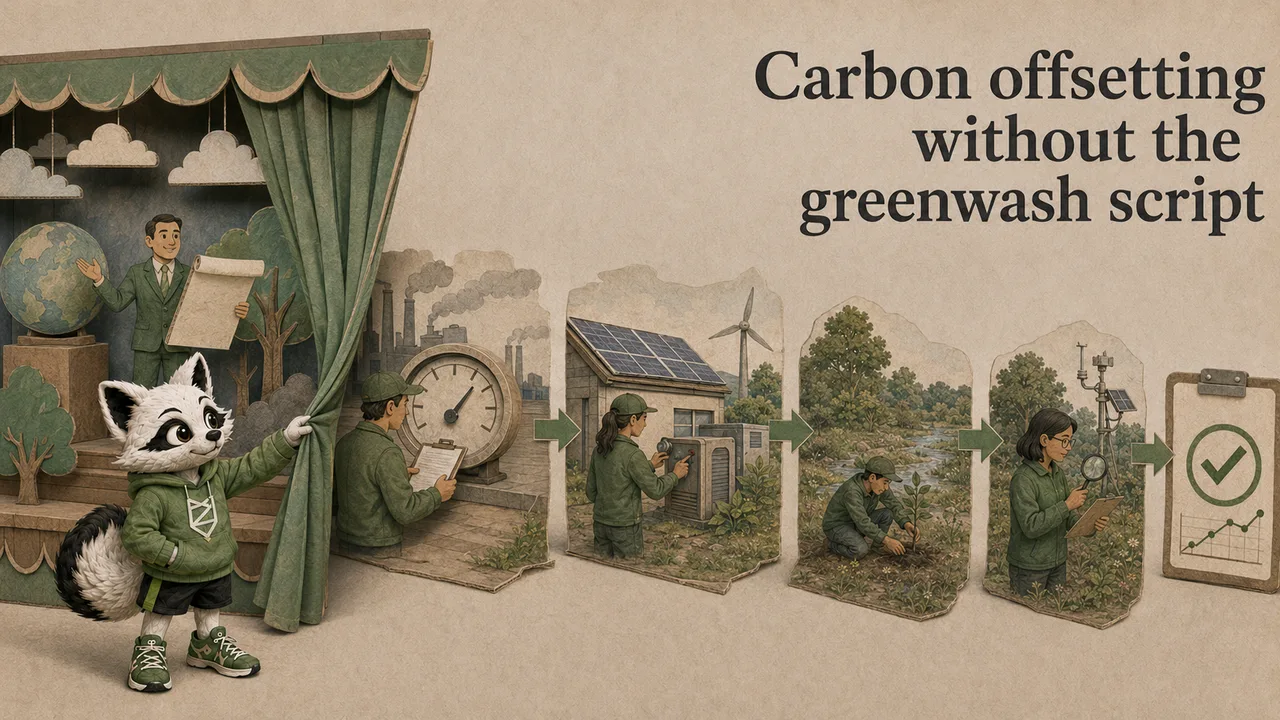
2026 giving data, and the tests a carbon brief still fails - additionality, permanence, and the difference between a pledge, a credit, and a tree.
A pledge is not a tonne. A tonne is not a tree.
A brand that briefs carbon as if a net-zero line were evidence is selling a script the official tests do not support. Purpose work still collapses a claim, a credit and a physical act into one film.
This page is the second of the environment trio. It owns carbon: additionality, permanence, and pledge versus evidence. Trees live on spoke 5. Oceans live later, as Oceans and biodiversity: the cause people name, the proof they rarely get. Maps, mechanism, children, local-versus-global and education live on earlier pages. This page does not reprint them.
This journal is published by Zenko Protocol, an engagement-and-impact platform. Not a product tour. Named 2022-2026 sources only. The site’s only confirmed public act is still 2,000 meals from the MK Dons Shop for Good programme, a food-poverty programme, not a carbon result.
TL;DR: A pledge is not a tonne, and a tonne is not a tree. CCC (2022): high-integrity credits are additional, not overestimated, long-lived and verifiable; overseas credits have strong evidence of overstatement; credits only supplement direct cuts. DESNZ (2024): credits in addition to value-chain action. ICVCM: additionality is a reduction that would not have happened without credit revenue; permanence is a reduction that stays out, or a compensated reversal. West et al., Science (2023): most of 26 voluntary REDD+ sites had not significantly cut deforestation; on 18 projects with public baselines, only 7% of potential offsets through 2020 would be additional under synthetic-control baselines. Trencher et al. (2024): 87% of offsets retired by the twenty largest buyers in 2020-2023 were high-risk. Buyer sample. Not “87% of offsets are junk.” Concern is not a gift: UNDP 80% want stronger government action; CAF UK environment £658m; BlueState about 6% of UK donors; Giving USA env+animals $24.57bn, 4%. This site names Rimba Raya and the on-page line “Verified carbon credits linked to protected biodiversity.” It does not name a tonne. Partner evidence of physical impact is not an on-chain participation record. 2,000 meals here are food poverty, not a carbon result.
The conventional brief still sells a pledge as a tonne
Most purpose work treats a net-zero line, a carbon credit and a physical environment act as one brand asset. They are three products. Only evidence survives a claim.
The pledge brief is easy to approve: logo-fit, an ESG slide, a “carbon neutral” film. None of those tests ask whether the credit is additional, whether it lasts, or whether the audience funds environment.
How people choose lives on spoke 1. This page stays on one lane and three products.
The CMA Green Claims Code is the consumer-law floor. Claims must be truthful, clear, complete and substantiated. If a business is offsetting, it should say so and name the scheme, or consumers can think the product itself emits little or nothing.
The UK government’s integrity principles (DESNZ, November 2024) put the same split in policy language. Principle 1: credits only in addition to value-chain action. Principle 5: accurate claims. A later consultation (April-July 2025; responses 26 March 2026) still awaits the government response. Principles, not a statute.
The Climate Change Committee’s 2022 advice is sharper still. Credits should only ever be supplementary to direct cuts. A business is only ‘Net Zero’ once nearly all scope 1, 2 and 3 emissions have been reduced, and the few remaining are counterbalanced with long-term removals. A film is not that state.
Pledge, credit, and a tree are not one product
A pledge funds a claim. A carbon credit funds a different product. A tree funds a physical act. The giving maps do not treat them as one lane, and this site does not either.
| Category | Pledge / “net zero” line | Carbon credit | Physical tree |
|---|---|---|---|
| What people think they fund | Neutrality | A tonne avoided or removed | Trees in the ground |
| What the gift actually is | A claim | A credit, a reserve, a methodology | A planting or restoration programme |
| Additionality | Not a test the film can pass | The first test. Would it have happened anyway? | A different product. Do not sell as a tonne |
| Permanence | A slogan does not last | The second test. Does it stay out, or is reversal compensated? | Physical act. Not this page’s essay |
| What a brand can show | A film | A named test - if one exists | A named physical act - if one exists |
| On this site | Not a lane | Rimba Raya. On-page language. No tonne count. | Eden. Earlier spoke |
| Verdict | Loses. Not evidence | Wins only if the tests are shown | Different product. One sentence UP |
That is not a vendor bake-off. Rimba Raya Biodiversity Reserve is the name on the five cause lanes people can choose as of the 20 August 2026 capture, with the on-page line “Verified carbon credits linked to protected biodiversity.” On-page language. Not a contract audit. Not a tonne inventory. Eden sits on trees; Second Life on oceans. Those names keep the split visible. The trees argument lives on spoke 5. Oceans live later, as Oceans and biodiversity: the cause people name, the proof they rarely get.
Verdict: brief the product you can show. Do not sell a pledge as a tonne, or a tonne as a tree.
Additionality is the first test a credit has to pass
A credit is additional only if the reduction or removal would not have happened without the incentive created by carbon-credit revenues. A pledge does not pass that test. Many credits fail it.
The Integrity Council for the Voluntary Carbon Market writes that as Core Carbon Principle 5: the reduction or removal “would not have occurred in the absence of the incentive created by carbon credit revenues.” That is the test. It is not a logo.
The Climate Change Committee’s Box 2.2 matches it. High-integrity credits are additional, not overestimated, long-lived, measurable and verifiable. Table 1 grades the evidence that overseas credits overstate reductions or removals as Strong. A qualitative grade. Not a CCC percentage. This page does not invent one.
A pantropical test sits next to that, not on top of it. West, Wunder, Sills and colleagues (Science, 25 August 2023; 26 voluntary REDD+ sites in six countries; synthetic controls) found that most of those sites have not significantly reduced deforestation. For those that did, reductions were substantially lower than claimed. On the 18 projects with public baselines, 61.7 million of 90.5 million potential offsets through 2020 (68%) came from projects that had not significantly reduced deforestation versus their synthetic controls. Replace those ex ante baselines with the counterfactuals and only 6.4 million (7%) would be additional. One Science sample. Not “68% of offsets are junk.” Not a reading of Rimba Raya.
A buyer-side finding sits next to that, still labelled. Trencher, Nick, Carlson and Johnson (Nature Communications, 10 August 2024) looked at the twenty companies that retired the most voluntary-market offsets in 2020-2023. 87% of those retirements fell in the SEI / GHG Management Institute high-risk project-type category for not providing real and additional reductions. Twenty buyers. A project-type screen. Not “87% of offsets are junk.”
DESNZ Principle 2 asks for the same discipline on the supply side: activity additional to that required by law, conservative baselines, independent validation, and measures to compensate reversals.
Permanence is the second test
A credit is permanent only if the reduction or removal stays out of the atmosphere, or there are measures to address reversal risk and compensate reversals. A film does not last.
ICVCM’s Core Carbon Principle 6 is the short version: permanent, or measures in place to address those risks and compensate reversals. DESNZ Principle 2 asks for the same compensation language on the UK side.
The Climate Change Committee is plain about the range. Projects differ in how long they last, and reporting does not always capture that. Land-based projects have over-claimed. Engineered removals with geological storage can be more permanent, but measurement is still evolving. A durability split. Not a licence to invent weather, modelled damages, or personal health effects.
Verra’s VCS Version 5 (fetched 21 August 2026) is a registry policy page, not a quality score for the partner on this site. More frequent baseline reassessments; an insurance or fund option for land-based reversal risk; most new-project rules from 1 January 2027. Permanence is still being rewritten. Not a vintage list. Not a Rimba audit.
A tree is a physical act, not this test. That product lives on spoke 5.
Concern is not a carbon gift
Most people want stronger climate action. Most of them do not give their money to environment or climate causes. A carbon brief that opens on concern is reading a poll, not a donor file.
The UNDP / University of Oxford Peoples’ Climate Vote 2024 (20 June 2024; more than 73,000 people, 77 countries) found 80% want their country to strengthen its climate commitments. That is concern about government. It is not a donation, and it is not “80% buy offsets.”
The gift, in the UK, is small. Environment took £658m in 2025 (CAF UK Giving Report 2026, 16 March 2026; YouGov; N=12,913; Figure 11). BlueState (April 2026; fieldwork 30 January-2 February 2026; N=2,136) puts environment and climate at about 6% of donors, against 7% in the 2024 column. In the US, environment and animals together took $24.57bn in 2025, 4% of giving (Giving USA 2026, 23 June 2026). Combined category. Small base. Do not write “Americans gave $24.57bn to carbon.”
The environment-lane version of this gap lives on spoke 5. The rule that three maps are not one ranking lives on the pillar.
This site names a reserve. It does not name a tonne
/causes/ lists carbon offsetting with Rimba Raya
Biodiversity Reserve and the on-page line “Verified carbon credits
linked to protected biodiversity.” On-page name, 20 August 2026 capture.
Not a confirmed tonne. Not a contract audit.
Do not invent vintages, registries, tonnes, or prices via this site. Do not add a second carbon NGO as a partner. Partner evidence of physical impact is not an on-chain participation record. Collapsing them is how “on-chain verified carbon” gets written on top of a name.
The only confirmed public act on this site is still the 2,000-meal programme. Food poverty. Not a carbon result. Do not restage it, and do not borrow it as a tonne.
See the five cause lanes if the next question is which carbon product a participant can pick.
Who should choose what
If the brief needs a carbon claim, show the tests. If it needs a nameable physical environment act, that is a different product. If it needs a net-zero film, stop.
Carbon claim. Additionality first, permanence second. Do not sell a pledge as a tonne.
Nameable environment act. Trees and rewilding live on spoke 5. Do not sell a tree as a tonne.
“Net zero via offsets.” The Climate Change Committee’s definition is an end state after nearly all emissions are cut. A film is not that state. Do not write it as a product on this site.
Sports organisation with a local, checkable act on another lane. Do not swap it for a carbon film. Geography lives on local vs global. Let the participant choose among the five live lanes. Do not add a sixth.
FAQ
Is carbon offsetting the same as planting a tree?
No. A tree is a physical act. A credit is a different product. This site already splits the lanes. Trees live on spoke 5.
What is additionality?
The reduction or removal would not have occurred without the incentive created by carbon-credit revenues (ICVCM, CCP 5). West et al. (2023) is why the test is not optional.
What is permanence?
The reduction or removal stays out of the atmosphere, or reversals are compensated (ICVCM, CCP 6; DESNZ Principle 2). A slogan does not pass.
Do people donate to carbon or climate?
Not as a mass cause. UNDP 80% is government action. UK environment is £658m and about 6% of BlueState donors. US environment and animals together are 4% of giving. This page does not invent a “most people buy offsets” poll.
What has this site actually delivered on carbon?
A named on-page partner and an on-page sentence. Not a confirmed tonne. The only confirmed public act is 2,000 meals: food poverty, not a carbon result.
A pledge is not evidence. Catch the brief up.
A net-zero film asks people to fund a claim. A credit is a different product. A tree is a different product again. Most people fund none of them.
- A pledge is not a tonne. CMA, DESNZ and the Climate Change Committee already name the tests.
- Additionality first, permanence second. West’s sample and Trencher’s twenty-buyer finding are scoped evidence, not a junk percentage.
- Concern is not a gift: UNDP 80%; BlueState about 6%; UK environment £658m; US environment and animals $24.57bn, 4%.
- This lane names Rimba Raya and an on-page sentence. It does not name a tonne. Meals on this site are food poverty, not a carbon result.
See the five cause lanes people can choose, or use Talk to us in the site navigation if the next step is a conversation with Zenko Protocol.
Continue through the Causes People Choose series
- Why people support the causes they support (and why brands still pick the wrong one)
- How people choose a cause
- Food poverty and feeding children
- Local vs global: why a shirt in Milton Keynes beat a world-saving slogan
- Why education and schools keep getting support
- Trees, rewilding, and what people think they are funding
- Carbon offsetting without the greenwash script
- Oceans and biodiversity: the cause people name, the proof they rarely get