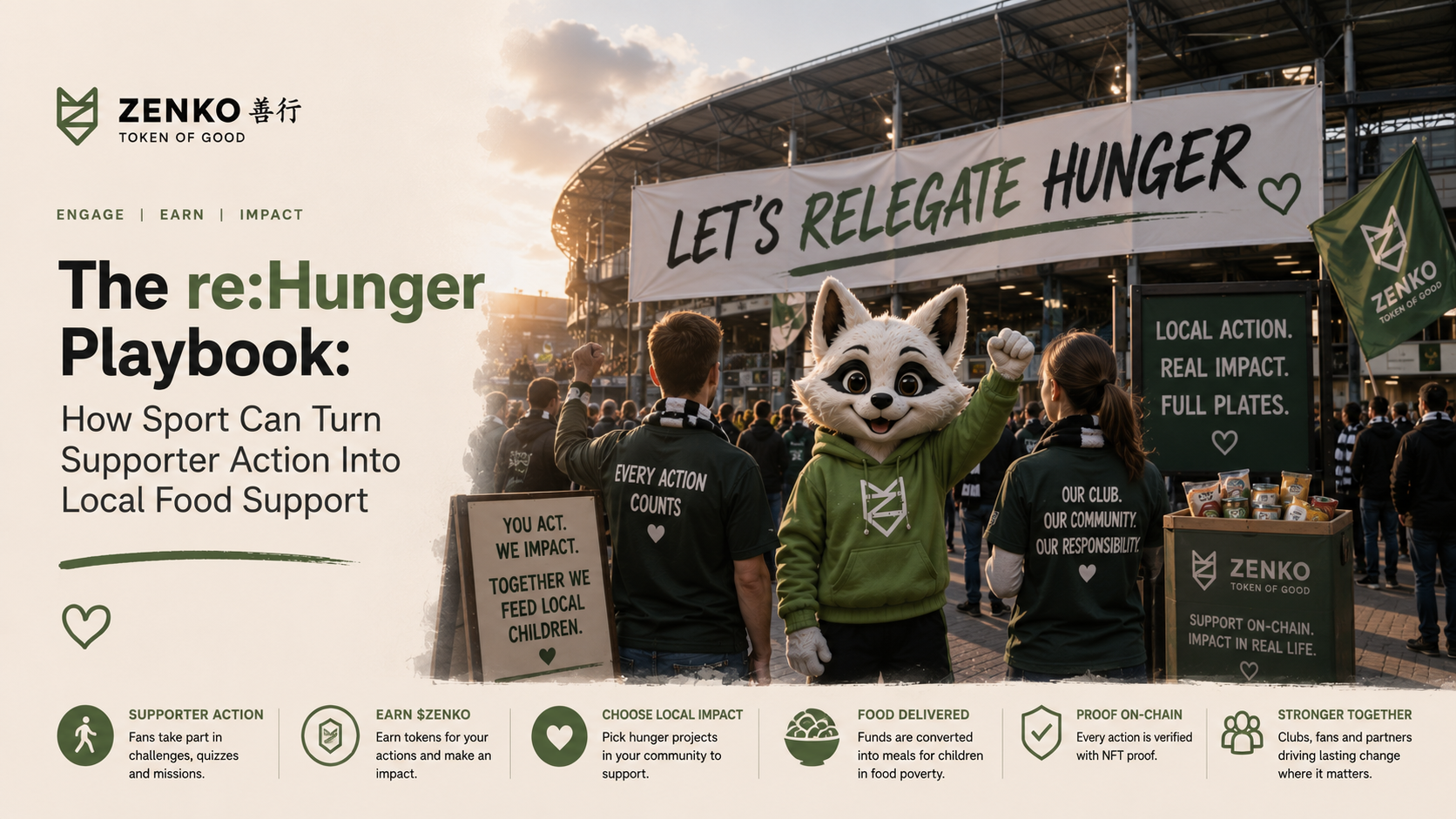
Sport cannot solve child poverty on its own. What it can do is turn existing reach, trust and repeated behaviour into specific, local, funded support that's easier for supporters to join and harder for organisers to fake than most alternatives, and, done well, cheaper per outcome and more traceable than routing the same funding through a generic, distant cause. This playbook pulls together the evidence and mechanisms from the rest of this series into one practical operating model: re:Hunger.
The current evidence, briefly
The most recent DWP data (published 26 March 2026) recorded 4.0 million children in relative poverty after housing costs. On food insecurity specifically, the trend has moved in a genuinely more positive direction recently: 2.0 million children (14%) were in food-insecure households in 2024/25, down from 2.6 million (18%) the year before, even as the Food Foundation's more current tracker shows roughly one in eight households food insecure by mid-2026. Read the full national evidence breakdown for definitions and sourcing on each figure, including the food-bank trend from Trussell showing parcel distribution easing from its 2023/24 peak.
Start with the place
National figures aren't a local programme brief. The local picture is genuinely uneven, London, the West Midlands and the North West all carry the highest regional child poverty rates in England, while named local authorities like Pendle, Bradford, Oldham and Birmingham record rates above 40%, and Scotland has bucked the national trend entirely with poverty falling to 21%. The local relevance guide sets out the five-step process for pulling current, defensible local data for a specific club catchment, sponsor territory or retail footprint, rather than assuming the national picture applies unchanged.
Use football's existing infrastructure
Football clubs combine a fixed local base, high-frequency repeated supporter contact, an existing retail and ticketing calendar, and, usually, an established community trust or foundation. This combination is explained in detail here, along with the honest limits: clubs are not food logistics or child-welfare specialists, and every credible programme pairs club reach with a named delivery partner.
Connect an ordinary action to a funded, hyperlocal outcome
Shop for Good is the specific mechanism Zenko has built for this: connecting an eligible purchase, proven through MK Dons' Buy a Home Shirt, Feed a Child programme, to a funded, evidenced outcome delivered by a named local partner sourcing within the club's own geography, typically at well under £1 per funded outcome, with a digital collectible confirming each supporter's own part in it. The full mechanism, and the MK Dons result, are set out here.
Learn from existing programmes
Football already has working models outside anything Zenko has built: Fans Supporting Foodbanks, running in 40+ clubs since 2015 and now a registered charity in its own right, and Trussell's Football vs Hunger charter, signed by clubs across England and Scotland. Six transferable design lessons from these programmes, credited to the organisations that built them, are here.
Publish proof, not PR
An announcement is not an outcome. The measurement guide sets out the evidence chain, action, attribution, funding, fulfilment, receipt, reporting, along with a pre-launch claims register and a ten-point checklist any programme owner can use, whether or not they work with Zenko at all, including how to handle a per-outcome cost claim and a digital collectible responsibly within that chain.
The complete operating model
- Establish local need using current primary data for the specific geography.
- Define one clear supporter action that already happens regularly.
- Secure funding for the outcome, from the club, a sponsor, or the retail structure itself.
- Appoint a delivery partner sourcing within that same local geography, and confirm their actual per-outcome cost and fulfilment capacity.
- Agree the conversion unit and any cap, in the delivery partner's own reporting language.
- Confirm the safeguarding and consent approach before any programme touching schools or children goes live.
- Launch with bounded, checked public claims, not aspirational ones, including any digital collectible mechanism explained clearly to participants.
- Track exceptions, failed transactions, refunds, anything that changes the real total.
- Verify fulfilment directly with the delivery partner before publishing anything.
- Publish the result in the delivery partner's own unit, with dates, geography and named partners, and review what worked before the next programme.
A decision guide for different readers
If you're a club: start with the local needs assessment, then decide whether a purchase-linked mechanism (Shop for Good), a fan-led collection model, or a charter commitment (or some combination) fits your resources and supporter base best.
If you're a sponsor or funder: the key question is what specific, evidenced outcome your funding will produce, in what unit, delivered by whom, and at what confirmed per-outcome cost within your own geography, not a general "impact" commitment.
If you're a retailer: the same purchase-linked logic used for a shirt can apply to other product lines; the constraints are delivery partner capacity, local sourcing and honest reporting, not the mechanism itself.
If you're a potential delivery partner: the value you bring is sourcing, logistics, safeguarding and, critically, the fulfilment evidence that makes the whole chain credible. That's a specific, valuable role, distinct from being a passive recipient of a marketing campaign.
Beyond this series: the full evidence report
For readers who want the deeper background research behind this cluster, the wider UK child food poverty evidence base, business-case material and further case studies, a downloadable report, Child Food Poverty in the UK: A Crisis Requiring Immediate Action, is available from Zenko as a supporting resource. That report was compiled in 2025 and includes figures and framing that predate the data in this series; read it alongside the current sourcing above, not as a replacement for it, and treat any statistic in the download as needing the same definition-geography-reference-period check applied throughout this cluster.
Partner with re:Hunger / Shop for Good
If you're a club, sponsor, retailer or delivery partner interested in exploring a programme, talk to Zenko about what a credible, evidenced, hyperlocal version could look like for your community.
Consolidated FAQs
Can sport actually solve child hunger? No single sport-for-good programme solves structural child poverty or hunger. What a well-designed programme can do is fund and evidence a specific, bounded local outcome, delivered by a named partner, reported honestly. That's a genuinely useful contribution, not a solution to the underlying causes.
What's the difference between Shop for Good, Fans Supporting Foodbanks, and the Football vs Hunger charter? Shop for Good is Zenko's purchase-linked, hyperlocal mechanism, proven through MK Dons. Fans Supporting Foodbanks is an independent, fan-founded matchday collection movement, now a registered charity. Football vs Hunger is a charter run by Trussell that clubs sign up to. All three are legitimate, separate approaches; none should be described as run by, or owned by, one of the others.
Why does Zenko talk about cost per outcome and a digital collectible specifically? Because they're the two mechanisms behind the model's central claim: that keeping delivery hyperlocal makes each outcome both cheaper to fund and easier for the supporter to trust, and the collectible gives the supporter their own confirmed record of taking part, distinct from the outcome itself which goes to the family or child supported.
How do I know if a sport-for-good programme's numbers are real? Check that the published result names a specific delivery partner, a specific geography, a specific date range, and uses the same unit the delivery partner itself reports in. If a per-outcome cost figure is quoted, check it's confirmed for that campaign specifically, not a general description of how the model works. If a number can't be traced to those things, treat it with caution.
Where can I read the full evidence behind this series? Each article in this cluster links its own sources inline. For a deeper downloadable resource, see the note above about the supporting report, used alongside, not instead of, the current sourcing in this series.