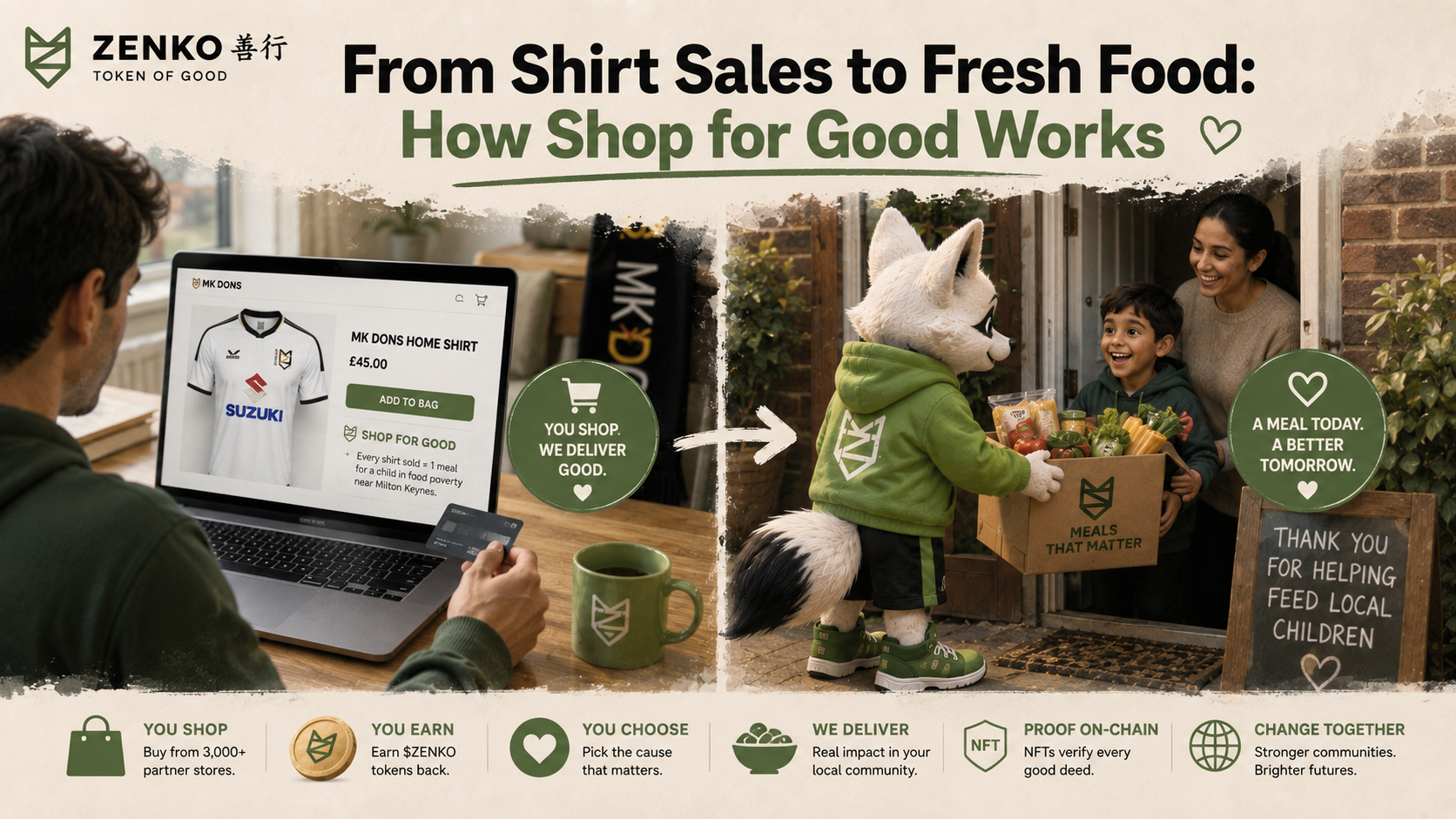
Shop for Good connects a purchase that's already happening, a shirt, a ticket, a piece of merchandise, to a second, separately funded and evidenced outcome. The supporter isn't asked to make a donation on top of their purchase; the outcome is funded by the club, sponsor or partner, and Zenko's role is to connect the transaction to that funding and to the local partner who actually delivers it. Two design choices sit underneath that mechanism and are worth understanding on their own terms: the model is built to be hyperlocal, and every eligible transaction generates a digital collectible for the supporter as their own proof of participation.
The roles involved
Five distinct parties sit inside every Shop for Good programme, and being clear about who does what is the difference between a credible programme and a vague marketing claim:
| Role | Who | What they do |
|---|---|---|
| Supporter | The customer | Makes a purchase they were already going to make (shirt, ticket, merchandise) |
| Club or retailer | The commercial partner | Runs the sale and hosts the campaign |
| Sponsor or funder | A brand, sponsor or the club itself | Funds the outcome, the actual cost of the food or other support |
| Zenko | The connecting layer | Links the eligible transaction to the funded outcome, issues the participation collectible, and supports evidence and reporting |
| Delivery partner | A named local organisation | Sources, prepares and delivers the real-world outcome, and confirms it happened |
The transaction-to-delivery flow
- A club or partner defines and funds a specific outcome, using a delivery partner sourcing within the club's or brand's own local geography.
- A supporter completes a purchase that qualifies under the programme's published rules.
- Zenko connects that purchase to the funded outcome, within any caps or conditions agreed in advance, and issues the supporter a digital collectible recording their participation.
- A named delivery partner sources, prepares and distributes the outcome to specified local recipients.
- The result is evidenced and reported, so the chain from purchase to funding to delivery to outcome can be traced and checked.
Why hyperlocal execution is the mechanism, not just the pitch
Food poverty is, as the earlier articles in this series show, a genuinely local problem, the same national average can sit above a well-off area's real experience and well below a struggling one's, sometimes within the same city. Zenko's model is built around that reality rather than around it. Instead of funding routed to a pooled, generic cause, a delivery partner is appointed within the club's or brand's own geography, sourcing surplus and near-date fresh produce from suppliers in that same area, and distributing it through named local schools and family hubs.
That design has two direct, practical consequences. First, it's what makes the outcome traceable at the level demonstrated by MK Dons: a specific quantity, delivered to four named Milton Keynes hubs, rather than a number that could describe activity anywhere. Second, it's what keeps unit cost down, sourcing locally and working with an established local redistribution partner typically means each meal-equivalent outcome can be funded for well under £1, because the model avoids the longer supply chains, higher overheads and generic distribution costs that come with routing funding through a distant, pooled cause. That sub-£1 figure describes how the model is designed to work in the geography a given programme runs in; it is not an independently audited average across every past Zenko programme, and any specific published figure for a live campaign should be confirmed against that programme's own delivery partner before it's used publicly.
The digital collectible: proof of participation, not a claim on the outcome
Alongside the funded outcome, which goes to the family or child the programme supports, the supporter who made the qualifying purchase receives a digital collectible: a record that they took part in this specific programme, tied to the campaign and, where relevant, the specific outcome their purchase helped fund. It exists to do two things. For the fan, it's a tangible, keepable record that their ordinary purchase did something beyond the purchase itself, the kind of thing a supporter can point to and say "that's mine, and here's what it did." For the club, sponsor and Zenko, it creates a clean, individually attributable link between a specific eligible transaction and a specific funded outcome, which is exactly the kind of granular record the measurement framework in this series argues any credible programme needs.
It's worth being precise about what the collectible is not: it is not the outcome itself (the food goes to the family, not to the fan), it is not sold or traded for value, and it should not be described in marketing as an investment or as having financial value, it's a participation record, not a financial instrument.
MK Dons: what was promised, what happened, and what was evidenced
MK Dons launched Buy a Home Shirt, Feed a Child alongside the release of their 2025/26 home shirt, in partnership with Zenko Protocol and Surplus to Purpose, a social enterprise that redistributes surplus food to community projects (EFL.com; MKFM). At launch, MK Dons chief executive Neil Hart described the aim as helping tackle food poverty affecting children in the city, with distribution coordinated through schools via Cleo: Sports for Good.
The reported outcome from the programme was The programme reported 2,000 meals' worth of fresh fruit and vegetables, sourced and fulfilled by Surplus to Purpose and delivered through four Milton Keynes community hubs: Fairfield's Primary School, Priory Rise School, Abbey's Primary School and Hedgerows Family Centre. The result is documented in Zenko's programme report; MK Dons' launch announcement confirms the partners and the original Buy a Home Shirt, Feed a Child commitment.
That distinction matters: the launch commitment was to fund an outcome per shirt sold; the delivery partner did the actual sourcing and distribution, within Milton Keynes itself; and the number published afterwards is what was verified as delivered, in the specific unit the partner reports in, "meals' worth of fresh fruit and vegetables," not a count of individual meals eaten or children permanently supported. Those are different claims, and this article uses the same unit the programme itself reported in rather than converting it into a bigger-sounding number.
Why inserting an outcome into an existing action reduces friction
Asking a supporter to make a separate donation, at a separate moment, competes for attention with everything else asking for the same thing. Attaching the outcome to a purchase they were already making removes that extra decision point, the supporter doesn't have to choose to give; the outcome is a property of a transaction they were completing regardless, and the collectible they receive afterwards is confirmation of that, not a request for anything further. This is a design choice with a real limitation too: because the supporter isn't asked to make an active giving decision, the programme's credibility rests entirely on the club or funder being transparent about the fact that the funding comes from them (or from a defined portion of the purchase price), not from an assumption the customer is personally donating.
The controls needed before launch
Before any Shop for Good programme goes live, the following need to be agreed and documented:
- Funding source, is the outcome funded by the club, a sponsor, or built into the retail margin, and is that clearly disclosed?
- Conversion unit, what, precisely, does one eligible transaction fund, in the delivery partner's own reporting unit?
- Caps, is there a maximum number of eligible transactions, and what happens once it's reached?
- Geography, which local area(s) will actually receive the outcome, and is the delivery partner genuinely sourcing within it?
- Delivery capacity, can the named partner actually source, store and distribute at the volume the campaign could generate?
- Per-outcome cost, has the funder confirmed the actual per-unit cost with the delivery partner, rather than assuming a headline "under £1" figure applies unchanged to this specific campaign?
- Evidence, what will be published afterwards, and in what unit?
- Public wording, has the campaign language been checked against what can actually be evidenced, before launch rather than after?
What Shop for Good does not prove yet
A Shop for Good programme evidences that a delivery partner received funding and reports having distributed a defined quantity of food to named local recipients. It does not, on its own, prove long-term impact on a family's food security, prove that sales increased because of the campaign, or prove a return on marketing investment, none of those claims should be made without programme-specific evidence collected separately. The measurement guide in this series sets out what a fuller evidence chain looks like.
Where the model could extend
The same mechanism could plausibly apply to season tickets, other merchandise lines, memberships or sponsor activations beyond shirts, each with its own local delivery partner and its own digital collectible design, these are possible future applications, not signed programmes, and shouldn't be presented as live offers until they exist.
Where Zenko fits
This entire article describes where Zenko fits: as the connecting layer between an eligible transaction and a funded, evidenced outcome delivered by a named local partner, built specifically around hyperlocal sourcing to keep unit cost low and the result traceable, with a digital collectible confirming the supporter's own part in it. Zenko is not the delivery partner, is not a charity, and does not itself source or distribute food.
FAQs
Does the customer pay extra when they buy a "Shop for Good" product? This depends on how the specific programme is structured and funded, and should be disclosed clearly in that programme's own terms, this article describes the general mechanism, not the pricing of any specific future campaign.
Is Shop for Good the same as a charity donation at checkout? No. A checkout donation is an extra, optional payment the customer chooses to make. Shop for Good connects an outcome the club or sponsor has already funded to a purchase the customer was making anyway, without asking them to give anything extra unless a specific programme is explicitly structured that way.
Why does Zenko emphasise "hyperlocal" specifically? Because it's the design choice that makes the model different from a generic donation or offset routed to a distant, pooled cause. Sourcing from local suppliers and delivering through named local schools and hubs both keeps the cost of each outcome low, typically under £1, and keeps the result traceable to the fan's own community rather than an abstract global total.
What is the digital collectible, and does it have monetary value? It's a record the supporter receives confirming they took part in a specific programme through a specific purchase, proof of participation, tied to the outcome their action helped fund. It is not the outcome itself, is not sold or traded, and shouldn't be treated as having financial value.
What exactly did the MK Dons programme deliver? The programme's reported outcome was 2,000 meals' worth of fresh fruit and vegetables, sourced and delivered by Surplus to Purpose through four Milton Keynes hubs. That is the unit the delivery partner reports in; it is not the same as a count of individual meals eaten.
Sources used
- EFL.com, Buy a home shirt, feed a child: MK Dons launch community-focused initiative
- MKFM, Milton Keynes Dons have launched Buy a Home Shirt, Feed a Child
- Zenko programme report: 2,000 Meals Delivered
- MK Dons launch announcement
- Zenko's hyperlocal sourcing model and digital collectible mechanism as described directly by Zenko
Next step: read why football's infrastructure suits this model, see other football hunger programmes worth learning from, or go straight to how to measure a programme like this properly.