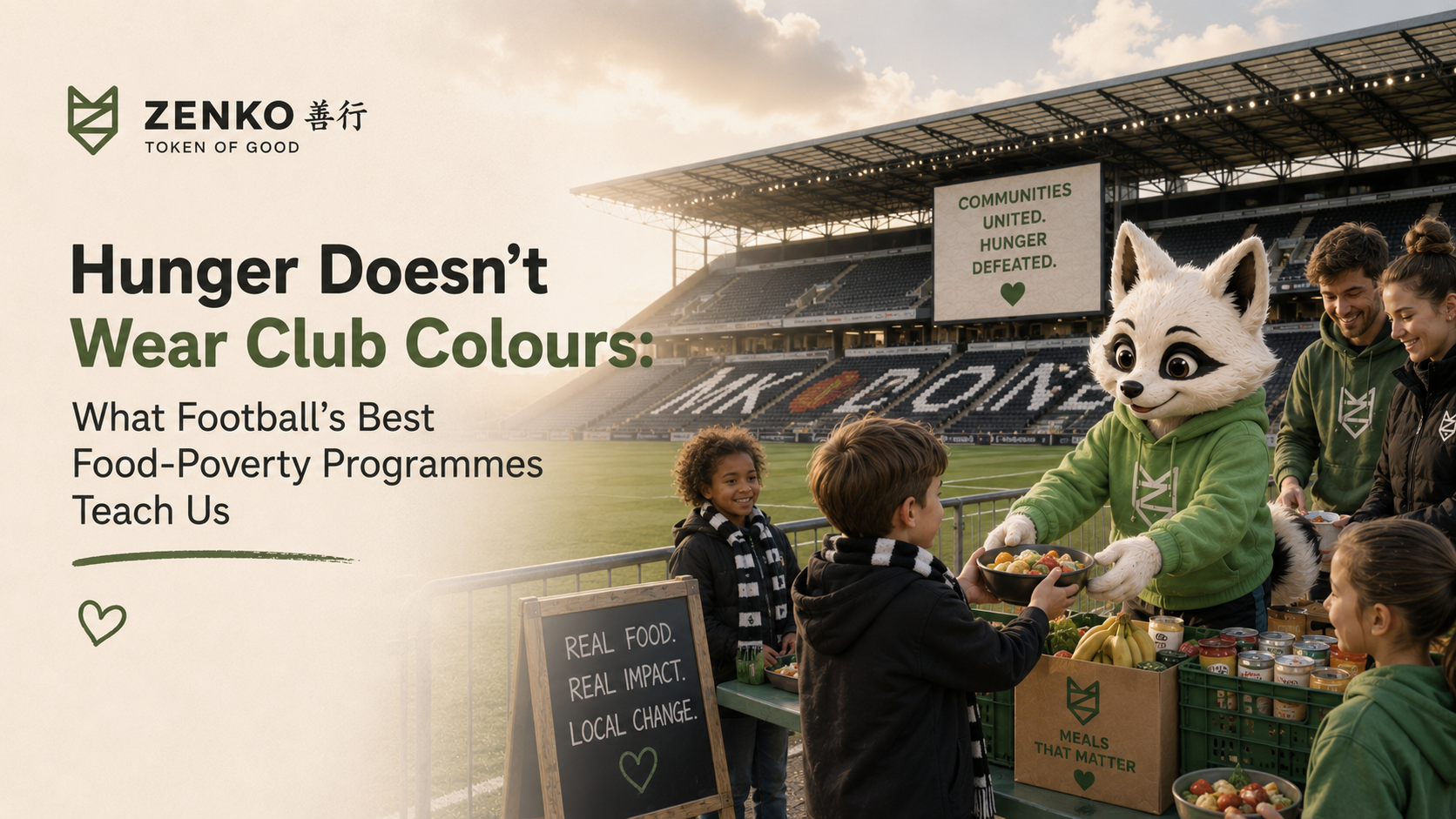
Football already has several working models for acting on hunger, run by supporters, by charities, and by clubs themselves. None of them were started by Zenko. This guide documents three verified programmes, credits the organisations behind them, and extracts the design lessons that any new programme, including Zenko's own, should learn from.
Fans Supporting Foodbanks
Problem or trigger: Rising need at food banks in Liverpool and Everton's shared home city, against a backdrop of austerity-era welfare cuts from 2010 onward.
Organiser: Founded in 2015 by Liverpool fan Ian Byrne and Everton fans Dave Kelly and Robbie Daniels, working through the Spirit of Shankly and Everton Supporters' Trust supporter groups (Wikipedia, citing organisational sources; BBC).
Supporter action: Matchday food collections outside both clubs' grounds, on a rival-derby footing that deliberately unites Liverpool and Everton supporters around a shared cause.
Delivery mechanism: Donations go directly to North Liverpool Foodbank and, over time, a wider network of fan-led groups.
Evidenced result: The initiative now supplies around 25% of all donations to North Liverpool Foodbank (Liverpool FC), and the wider "Hunger doesn't wear club colours" movement now operates in more than 40 clubs nationally (BBC). In 2025, the organisation marked its ten-year anniversary and gained charitable status, making it eligible for public funding and grants after a decade funded, in its own founder's words, entirely by local generosity (BBC).
Design lesson: A cross-rivalry framing ("hunger doesn't wear club colours") can turn two competing fanbases into one campaign, and a fan-led model can sustain a decade of activity without needing a large central budget, still growing to a formal charity a decade in rather than fading out.
Limitation: The model depends heavily on volunteer capacity and matchday footfall; it isn't a substitute for year-round, non-matchday support, and it grew organically rather than being centrally coordinated across clubs from the start.
Trussell's Football vs Hunger charter
Problem or trigger: Trussell's own data on food-bank demand around football's core fanbase, during the 2023/24 Premier League season alone, food banks in the Trussell network distributed 2.5 million emergency food parcels across the UK, including over 900,000 for children (TFN), set against Trussell's long-run growth from around 1.1 million parcels in 2015 to a 2023/24 peak of 3.12 million, easing to 2.6 million in 2025 (House of Commons Library CBP-8585).
Organiser: Trussell, the UK's largest food bank charity network.
Supporter action: Clubs sign a charter committing to specific actions, including challenging poverty-related chanting in and around grounds, and encourage fans to sign up to "Trussell FC," a supporter network backing Trussell's wider campaign to end the need for food banks.
Delivery mechanism: Individual clubs organise their own local activity under the charter, often working with an existing local food bank, alongside Trussell's national campaigning.
Evidenced result: Multiple clubs across England and Scotland, including Liverpool, Everton, St Johnstone, Motherwell, St Mirren and Bromley, have signed the charter, with Liverpool running a dedicated food drive ahead of a Merseyside derby to mark their signing (Shropshire Star; Bromley FC Community Trust).
Design lesson: A shared charter gives clubs a common standard to sign up to without requiring every club to design a programme from scratch, and pairs a symbolic commitment (challenging stigmatising chanting) with a practical one (fan-facing food-bank support).
Limitation: Signing a charter is a commitment to a set of actions, not itself a food distribution programme, the on-the-ground impact still depends entirely on what each individual club does under it.
MK Dons Shop for Good
Problem or trigger: Locally identified need in Milton Keynes, addressed through a purchase-linked, hyperlocal mechanism rather than a collection or charter model.
Organiser: MK Dons Football Club, working with Zenko Protocol and Surplus to Purpose.
Supporter action: Buying the club's 2025/26 home shirt.
Delivery mechanism: Zenko connected eligible purchases to a funded outcome and issued supporters a digital collectible as proof of participation; Surplus to Purpose sourced and delivered fresh produce from within the local area; distribution was coordinated with schools via Cleo: Sports for Good.
Evidenced result: 2,000 meals' worth of fresh fruit and vegetables delivered through four Milton Keynes community hubs (see the full case study for the complete detail, including what is and isn't proven by this outcome, and how the hyperlocal, sub-£1 mechanism worked in practice).
Design lesson: Attaching an outcome, and a keepable record of participation, to a purchase that's already happening can reduce the friction that limits collection-based campaigns to matchday footfall alone, while local sourcing keeps both cost and traceability tight.
Limitation: As with any purchase-linked model, the total outcome scales with retail sales rather than with local need directly, so caps and clear reporting matter to avoid over- or under-promising relative to what's actually funded and delivered.
What supporter-led, charter-led and purchase-linked models do differently
Fans Supporting Foodbanks shows what sustained, volunteer-led collection can achieve over a decade, evolving into a registered charity along the way. Football vs Hunger shows how a shared charter can coordinate commitment across many clubs without forcing identical programmes. Shop for Good shows how an existing commercial transaction, kept deliberately local in its sourcing, can be the delivery mechanism instead of a separate ask. None of the three approaches is universally "better", they suit different clubs, different resources, and different starting points.
Six transferable principles
- Attach the ask to something that already happens regularly, whether that's a matchday collection or a purchase.
- Name the delivery partner publicly, rather than implying the club itself distributes the outcome.
- Use a shared standard or charter where one exists, rather than reinventing commitments other clubs have already agreed.
- Report in the same unit your delivery partner reports in, not a converted or inflated figure.
- Keep delivery local wherever possible, it's both a cost advantage and a trust advantage, letting supporters see the outcome land in their own community.
- Build in a limitation statement alongside every published result, what the number does and doesn't prove.
Where Zenko fits, and where it doesn't
Zenko's own case study here is MK Dons Shop for Good, and only that programme. Zenko did not create, own or operate Fans Supporting Foodbanks or the Football vs Hunger charter, and this article does not imply otherwise. Where Zenko fits more broadly is in the purchase-linked, hyperlocal model described above; the fan-led and charter-led models remain, and should remain, owned by the organisations that built them.
FAQs
Who started Fans Supporting Foodbanks? Liverpool fan Ian Byrne and Everton fans Dave Kelly and Robbie Daniels founded it in 2015, working through the Spirit of Shankly and Everton Supporters' Trust supporter groups. It is not a Zenko or Cleo programme.
What is the Football vs Hunger charter? A charter run by Trussell that football clubs can sign, committing to actions such as challenging poverty-related chanting and promoting fan-facing support for food banks. Multiple English and Scottish clubs have signed it.
Is "Hunger doesn't wear club colours" a Zenko phrase? No. It is associated with Fans Supporting Foodbanks and should be credited to that organisation, not presented as Zenko's own campaign language.
What did the MK Dons programme actually deliver, and how? 2,000 meals' worth of fresh fruit and vegetables, delivered through four Milton Keynes community hubs, sourced locally and distributed by Surplus to Purpose, with each qualifying purchase generating a digital collectible for the supporter. Full detail is in the Shop for Good case study.
Sources used
- Wikipedia, Fans Supporting Foodbanks
- BBC, 'We will celebrate when our charity is shut down'
- BBC, Football fans helping foodbanks back for fourth year
- Liverpool FC, Cadbury and Fans Supporting Foodbanks unite to help local communities
- Trussell, Football vs Hunger club charter
- Shropshire Star, Football community unites to relegate hunger to history
- Bromley FC Community Trust, Trust signs Football vs Hunger charter
- TFN, Football clubs unite to relegate hunger
- House of Commons Library, Food banks in the UK (CBP-8585)
Next step: see the full MK Dons Shop for Good case study, or move on to the measurement framework these lessons feed into.