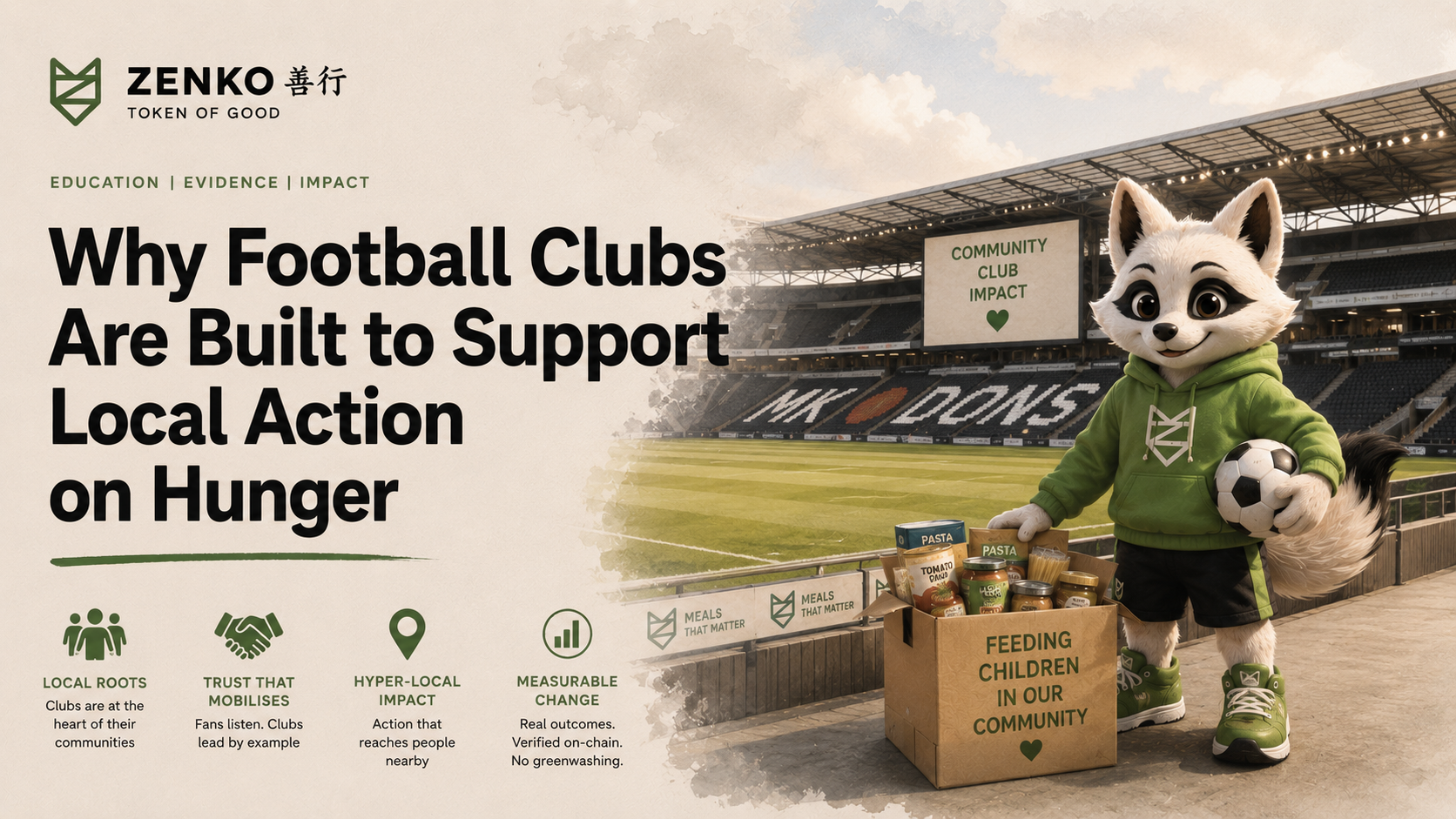
Football clubs aren't good at fighting hunger because of celebrity or sentiment. They're useful because they already have the infrastructure: a fixed local base, repeated supporter behaviour, retail and ticketing moments that happen every fortnight, communications reach into a defined community, and, in most cases, a foundation or community trust that already runs local programmes. That combination is genuinely rare outside football, and it's worth being precise about why it works, and where it stops working, rather than treating "football cares" as a full explanation.
Football's advantage is infrastructure and repeated behaviour
A retailer might see a customer a handful of times a year. A football club sees a season-ticket holder roughly 23 times a season, at the same ground, alongside the same few thousand neighbours, for a shirt, a programme, a pie, a pint. That repetition is what makes a purchase-linked or activity-linked programme viable in a way it often isn't for a one-off retail brand: the club can build a recognisable, recurring mechanism into something supporters already do, rather than asking for a new behaviour altogether.
Local identity and trusted institutions
Most EFL and lower-league clubs are among the oldest continuously operating institutions in their town, often older than the local authority boundaries around them. That long local history, combined with the fact that supporters actively choose to identify with the club rather than being assigned to it, creates a level of trust that a new corporate campaign in the same area typically has to spend years building. Fans Supporting Foodbanks, founded in 2015 by Liverpool and Everton supporters and now supplying around a quarter of donations to North Liverpool Foodbank (Liverpool FC), is the clearest evidence that this trust converts into sustained, voluntary participation rather than a one-off publicity moment.
Existing commitments across the sport
This isn't a single club's initiative. Trussell's Football vs Hunger charter has been signed by clubs across England and Scotland, including Liverpool, Everton, St Johnstone, Motherwell, St Mirren and Bromley among others, committing signatories to specific actions such as challenging poverty-related chanting and promoting food-bank support to fans (Trussell charter). Fans Supporting Foodbanks itself now operates in more than 40 clubs nationally under the "Hunger doesn't wear club colours" banner (BBC). That existing base of activity, not started by any single commercial partner, is what a new programme joins, not invents.
The retail and ticketing moment, and why local execution matters here specifically
Every home shirt launch, season-ticket renewal, and matchday food purchase is an existing commercial transaction that already happens at scale, on a predictable seasonal calendar. That predictability matters practically: a delivery partner can plan food sourcing and distribution capacity around a known shirt-launch date in a way that's much harder with an unplanned, ad-hoc appeal.
It also creates a specific opportunity that a generic national or global cause can't match: the club's own supporters are, by definition, concentrated in and around the club's own city. A mechanism that keeps the funded outcome in that same geography, sourcing surplus or near-date produce from local suppliers, delivering through named local schools and family hubs, turns "buy a shirt" into something a fan can trace directly back to their own community, rather than an abstract donation that could, for all the fan knows, be funding something on the other side of the world. That local traceability is also what keeps the cost of each individual outcome down, because it avoids the longer supply chains and overheads that generic global giving models typically carry.
What football's advantage does not include
None of this means football clubs are equipped to run large-scale food logistics, assess individual family need, or safeguard vulnerable children without a specialist partner. Clubs are good at reach, trust and a recurring commercial moment; they are not, on their own, food redistribution charities or child welfare specialists. Every credible programme in this space, Fans Supporting Foodbanks, the Football vs Hunger charter signatories, and MK Dons' Shop for Good programme, pairs the club's reach with a named delivery partner who actually sources, prepares and distributes the food. Claiming a club alone can "solve" hunger in its area overstates what any of these programmes actually do.
Where Zenko fits
Zenko's role here is to make the connection between a club's existing commercial moment and a funded, evidenced outcome delivered by a named local partner, as described in detail in how Shop for Good works, including how Zenko's hyperlocal design and its per-purchase digital collectible are meant to work together. Zenko does not replace the club's community trust or the delivery partner's food logistics; it connects the two and helps report the result. Before launching, the groundwork covered in the local needs assessment guide still needs to happen first.
FAQs
Why are football clubs specifically useful for this kind of programme, rather than any local business? The combination matters more than any single factor: a fixed local base, high-frequency repeated contact with the same supporter base, an existing retail/ticketing moment, and, usually, an established foundation or community trust already running local programmes. Few other local institutions combine all four.
Can a football club run a food distribution programme on its own? Not credibly at scale. Every established example, Fans Supporting Foodbanks, Football vs Hunger signatories, MK Dons' Shop for Good, pairs the club's reach and trust with a specialist delivery partner who handles sourcing, storage and distribution.
Is this only relevant to Premier League clubs? No. Fans Supporting Foodbanks and the Football vs Hunger charter both span clubs well outside the Premier League, including EFL and Scottish clubs. Local trust and repeated matchday contact exist at every level of the professional game.
Why does it matter that a club's own supporters live in the same city the outcome is delivered in? Because it makes the connection between the purchase and the outcome tangible and traceable rather than abstract, the fan can see the campaign is funding something in their own community, not a generic cause somewhere else, and that local sourcing is also what keeps the cost of each outcome low.
Sources used
- Liverpool FC, Cadbury and Fans Supporting Foodbanks unite to help local communities
- BBC, Football fans helping foodbanks back for fourth year
- Trussell, Football vs Hunger club charter
- TFN, Football clubs unite to relegate hunger
Next step: see the mechanism itself in how Shop for Good works, or read more football precedent in what football's best food-poverty programmes teach us.