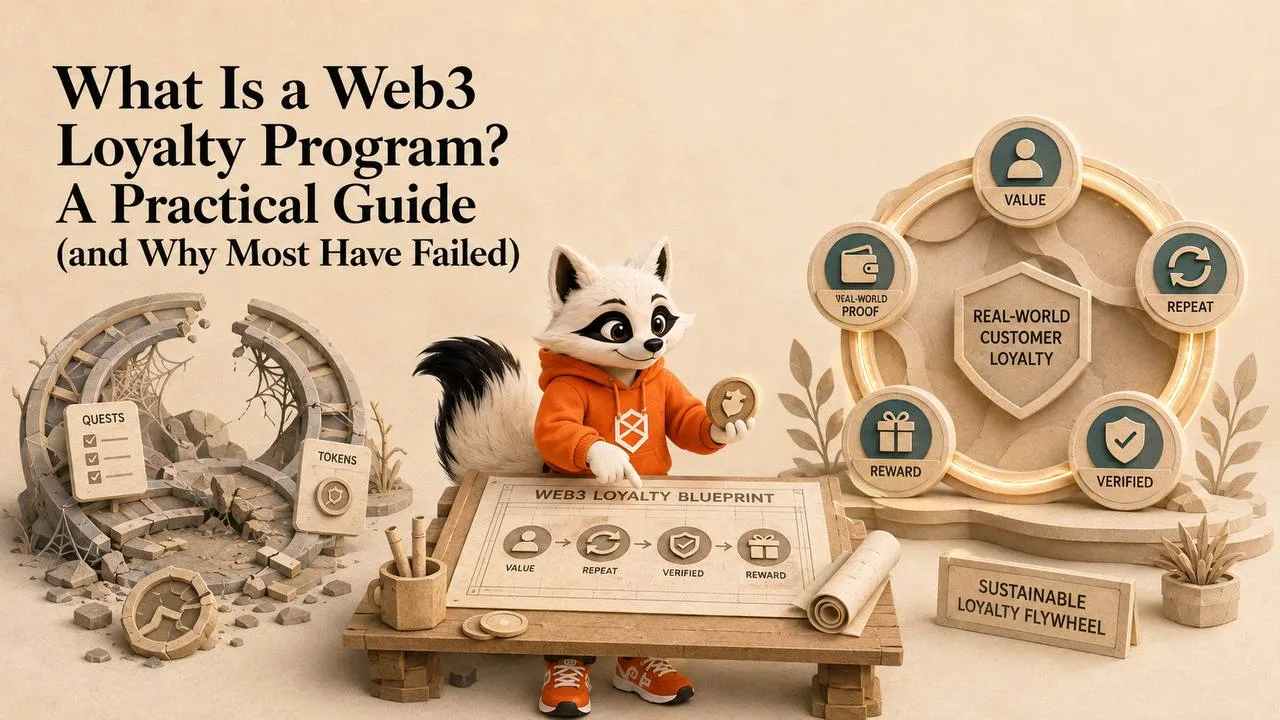
A Web3 loyalty programme rewards customer actions using blockchain-based assets, tokens or NFTs, instead of, or alongside, traditional points. In principle that adds three things a points ledger can't: rewards a customer can actually own and transfer, portability across brands and platforms, and a public, tamper-proof record of what was earned and why. In practice, most Web3 loyalty programmes launched by major brands so far have delivered the mechanics without ever answering why a customer should care, and they've closed as a result.
This piece is part of Zenko's Web3 loyalty series. For the overall argument, see Web3 Loyalty Programs: Why Verified Action Beats Quest Farming in 2026.
How a Web3 loyalty program actually works
Strip away the branding and most programmes follow the same loop: a customer completes an action (a purchase, a quiz, a social follow, attendance at an event), the brand mints or transfers a token or NFT to the customer's wallet as proof, and that token can then be redeemed, traded, staked, or used to unlock further perks. The blockchain's job in this loop is verification and ownership. It's not what makes the reward valuable; what makes the reward valuable is whether the underlying action was worth rewarding in the first place.
That last sentence is where most launches have gone wrong.
Why the highest-profile examples failed
Starbucks Odyssey. Launched in beta in late 2022, Odyssey let Starbucks Rewards members complete "Journeys", games, quizzes, and purchase-linked challenges, to earn "Journey Stamp" NFTs. Starbucks announced on 15 March 2024 that it would close the programme by the end of that month. The most consistent explanation across coverage at the time was that the NFT layer added complexity without adding a clear reason to participate, especially next to a core Starbucks Rewards programme that was already working: 33.8 million active US 90-day members in the most recent quarterly figures available at the time, up 4% year over year.
Nike RTFKT. Nike acquired the NFT studio RTFKT in December 2021, at the peak of NFT interest. RTFKT announced it would wind down operations by the end of January 2025, and Nike quietly sold the studio outright in mid-December 2025 under CEO Elliott Hill's "back to basics" strategy. The broader market context didn't help: monthly NFT sales had fallen to roughly $320 million by November 2025, with total NFT market capitalisation down more than 67% year over year.
The wider pullback. GameStop closed its NFT marketplace in January 2024, citing regulatory uncertainty. X discontinued NFT profile pictures the same month. Meta wound down its NFT features in 2023. None of these were small experiments; all were resourced bets by major consumer platforms, and all were shelved within roughly two years.
What's actually working
The programmes still standing share a common trait: the token does something a points balance can't, rather than just imitating one.
- Blackbird ($FLY) is a restaurant loyalty network where the token can be spent directly on meals at partner venues, real, immediate utility rather than a speculative asset.
- Reddit's Collectible Avatars succeeded largely because they layered onto behaviour users already had (an existing avatar and profile culture), rather than asking users to learn a new one.
- Singapore Airlines' KrisFlyer/KrisPay uses blockchain for miles tracking and redemption, an infrastructure upgrade to an existing, trusted programme rather than a parallel system competing with it.
The pattern: blockchain works as plumbing for a loyalty programme people already have a reason to use. It doesn't work as the reason itself.
The market context
Web3 loyalty is still a minority interest inside the loyalty industry, not a mainstream shift. EY's 2025 loyalty research found only 22% of loyalty-programme operators named "adding blockchain technologies" among their planned investments, well behind personalisation and experiential rewards. Market-research firms project rapid growth in dollar terms for the underlying platform category, estimates range roughly from the low billions today to the high single-digit billions by the end of the decade, depending on the publisher, but these are vendor projections built on undisclosed methodology, not verified market data, and should be treated as directional rather than exact.
What to check before building or joining one
- Does the reward require a real action, or just a wallet connection and a click? Programmes built on the latter are quest farming with a loyalty label.
- Is there a reason to use the token beyond selling it? Blackbird's $FLY works because it pays for something real.
- Does the programme replace a working system, or sit alongside one? Odyssey replaced nothing; it added friction on top of Starbucks Rewards.
- What happens to engagement after the first reward is claimed? This is the single best predictor of whether a programme is loyalty or farming, covered in full in What Is Quest Farming?
FAQ
What's the difference between a Web3 loyalty program and a traditional points program? Mechanically, a Web3 programme issues blockchain-based tokens or NFTs instead of, or alongside, points in a closed database. The tokens can be owned, transferred, and verified independently of the brand's own systems. Whether that difference matters to the customer depends entirely on whether the token does something a points balance couldn't.
Do Web3 loyalty programs actually increase customer retention? The evidence is mixed and depends heavily on design. Programmes built around genuine product usage, see the Optimism Airdrop 5 data covered in the pillar piece, show materially better retention than programmes built around task completion or points farming.
Why did Starbucks and Nike both step back from Web3 loyalty? Both cited the added complexity versus their existing, already-successful loyalty programmes, and both moves came during a broader pullback in consumer NFT engagement, NFT market capitalisation fell more than 67% year over year heading into late 2025.