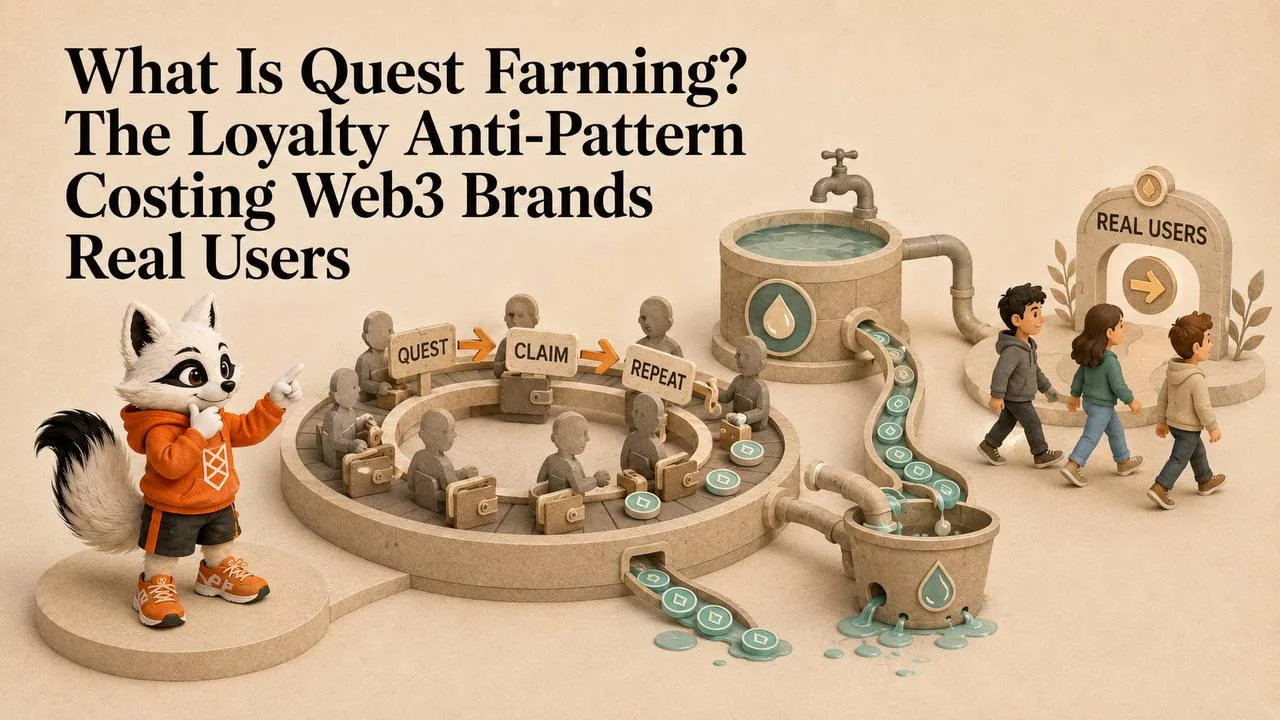
Quest farming is the practice of completing the minimum set of tasks required to qualify for a token, NFT, or airdrop reward, with no genuine intention of engaging with the product afterwards. It's the Web3 version of gaming any rewards system: the participant optimises for the reward, not the relationship the reward was meant to build.
This piece is part of Zenko's Web3 loyalty series. For the full argument, see Web3 Loyalty Programs: Why Verified Action Beats Quest Farming in 2026.
How quest farming actually works
Most Web3 "earn" programmes run on quest platforms like Galxe, Zealy (roughly 700,000 monthly active users), or Layer3, which list a set of tasks, follow an account, join a Discord, complete a quiz, make a small on-chain transaction, that unlock a reward on completion. Genuine users complete these because they're curious about the product. Farmers complete them purely because the reward exists, often running the same task list across dozens or hundreds of wallets to multiply the payout. AP Collective, which advises Web3 marketing teams, describes it plainly: quest farming is "the well-documented problem" where "participants complete the minimum required actions to claim rewards without genuine engagement with the protocol."
What happens after the reward is claimed
The clearest evidence of quest farming's cost comes from what recipients do immediately after claiming. When Dune Analytics studied the Uniswap UNI airdrop, of roughly 220,000 eligible wallets, only 6.7% still held any UNI a year later. More than 75% sold within a week of the claim, rising to 85% within three months, and close to 98% never once participated in the governance process the token was designed for. The same study found 1inch retention at just 7.9%, and LooksRare saw roughly 85% of recipients sell despite built-in staking incentives designed to discourage exactly that.
More recent data shows the same pattern holding. Nansen's analysis of ZKsync's 2024 airdrop found that among the top 10,000 recipient wallets, more than 41% sold their entire allocation on the first day, with claimants selling roughly $500 million of ZK combined. Ether.fi's ETHFI token fell around 25% within hours of its debut as points-farmers claimed and immediately sold.
Sybil farming: quest farming at scale
Individual quest farming becomes a much bigger problem when the same person runs it across many wallets. LayerZero identified enough suspected multi-accounting ahead of its 2024 airdrop that it set a self-report deadline of 17 May, with compliant farmers keeping only 15% of their original allocation; daily cross-chain transactions on the network fell by more than half in the weeks following the snapshot. Arbitrum's team separately confirmed nearly 149,000 sybil addresses that had passed its eligibility checks, together capturing an estimated 21.8% of the entire token distribution. A developer analysis attributed roughly 700,000 addresses on Starknet to repeat or renamed accounts.
Dragonfly's State of Airdrops report (March 2025) describes the resulting pattern directly: farmers "instantly stop farming and sell upon claim, rarely engaging with the project afterwards," a behaviour the report says has "diluted the effectiveness of airdrops" as a growth tool industry-wide.
Named commentary from inside the industry backs this up. Dragonfly managing partner Haseeb Qureshi put it bluntly in September 2025: broad, undifferentiated airdrops "only incentivize farmers to generate artificial activity that disappears after TGE." Compound founder Robert Leshner made a similar point about his own protocol's token distribution a year earlier: "People are gaming metrics to get money, creating a convoluted system... This system doesn't seem to work that well for distributing a token."
The controlled counter-evidence
The most useful data point isn't just "farming is bad." It's a direct comparison of what happens when the same programme rewards farming behaviour versus genuine usage. Optimism's Airdrop 5 (October 2024) split its bonus categories along exactly this line. Bonuses tied to real cross-chain product usage raised 30-day retention by up to 10 percentage points. A bonus tied to "frequent activity", the metric closest to farming behaviour, cut 30-day retention by 7.1 percentage points. Optimism's own researchers attributed the negative effect to farmers who sell their reward and leave immediately, exactly the pattern seen in the Uniswap and ZKsync data.
What quest farming costs a brand
Beyond the wasted reward budget, quest farming produces misleading engagement metrics. A campaign can report thousands of "completed actions" that are almost entirely farmed, with real, retained users making up a small fraction of the headline number, precisely the trap Optimism's frequency-based bonus fell into before the data revealed it.
FAQ
What is quest farming in crypto? Completing the minimum tasks on a quest platform (Galxe, Zealy, Layer3, or similar) purely to qualify for a token or NFT reward, without genuine interest in the product. It's typically identifiable by high claim-and-sell rates and low subsequent engagement.
How common is airdrop sybil farming? Significant in scale where measured directly: Arbitrum confirmed nearly 149,000 sybil addresses capturing an estimated 21.8% of its token distribution, and LayerZero's pre-airdrop crackdown coincided with a more than 50% drop in daily cross-chain transactions.
How can a brand tell if its "engagement" is real or farmed? Check what happens after the reward is claimed. In documented cases, real engagement (Optimism's genuine-usage bonuses, Hop Protocol and ENS's airdrops) retained users at multiples of the rate seen in farming-heavy distributions like Uniswap's or LooksRare's.