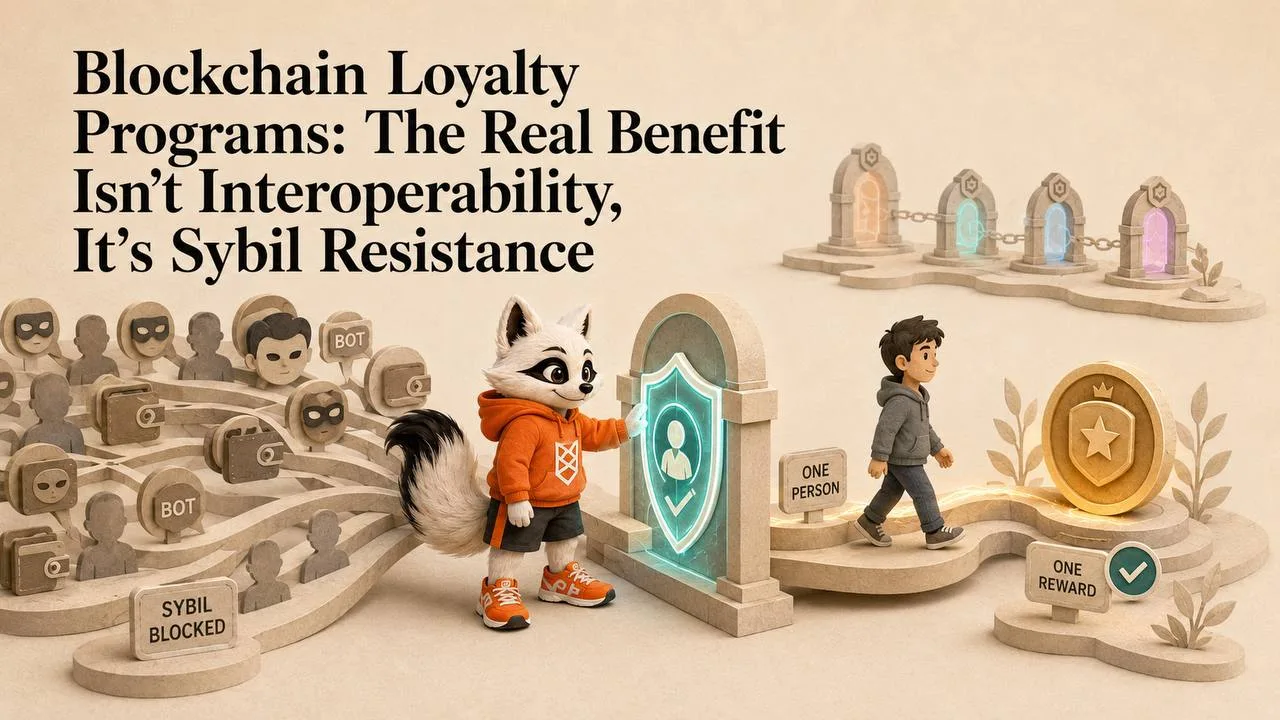
Most explanations of blockchain loyalty programmes lead with interoperability: tokens that work across brands, smart contracts that automate redemption, tamper-proof records instead of a database a support agent can edit. Those are real, useful properties. They're also not the benefit that actually protects a loyalty budget. The benefit that does is sybil resistance, the ability to tell a genuine customer from someone running fifty wallets to claim the same reward fifty times.
This piece is part of Zenko's Web3 loyalty series, alongside the pillar piece, Web3 Loyalty Programs: Why Verified Action Beats Quest Farming in 2026, and What Is Quest Farming?, which covers the farming behaviour this section is designed to prevent.
Why interoperability isn't the load-bearing benefit
A tamper-proof ledger and cross-brand portability are genuinely useful engineering properties. But a traditional points database can already do the two things that matter most to a marketing budget: track who did what, and prevent the same action from being rewarded twice. The reason blockchain-based systems get built instead is usually one specific failure mode traditional systems handle badly at scale: telling apart one real person claiming a reward once from one person claiming it many times through multiple accounts.
The scale of the sybil problem
This isn't a theoretical concern. When LayerZero prepared its 2024 airdrop, it identified enough suspected multi-accounting that it gave suspected farmers a self-report deadline of 17 May, with those who complied keeping only 15% of their original allocation. In the weeks following the token snapshot, daily cross-chain transaction volume on the network fell from roughly 300,000 to around 150,000, more than half, evidence that a large share of "activity" on the network existed only to farm the reward.
Arbitrum's team later identified close to 149,000 confirmed sybil addresses that had passed its own eligibility checks, together capturing an estimated 21.8% of the entire airdrop. A separate developer analysis attributed roughly 700,000 addresses on Starknet to repeat or renamed accounts tied back to a smaller set of real actors. In each case, the reward programme worked exactly as designed and still lost a fifth or more of its budget to fraud, because the underlying system had no reliable way to prove one wallet equalled one person.
How proof-of-personhood and verified action close the gap
A 2022 research paper by Puja Ohlhaver, Glen Weyl, and Ethereum co-founder Vitalik Buterin, "Decentralized Society: Finding Web3's Soul," proposed non-transferable "soulbound" tokens as a way to encode a person's real commitments, credentials, and affiliations on-chain, specifically to enable sybil-resistant systems. That idea now has practical implementations: proof-of-personhood tools like Human Passport (formerly Gitcoin Passport) and Humanity Protocol let a programme check that a wallet is controlled by a unique, verified human before it can claim a reward.
Verified-action models take this a step further. Rather than proving personhood alone, they require proof that a specific real action happened, a course completed, a purchase made, an event attended, before any reward is released. That's structurally harder to fake at scale than clicking through a quest list, because each claim has to correspond to something that actually occurred.
What this looks like in a production loyalty program
Zenko's reward model is built around this exact principle: the token only releases once the underlying action is verified, whether that's a completed learning module, a confirmed purchase, or an activity tracked and matched against a real person. In practice, this is the same design logic that let HP cut its cost-per-lead by 35% running a reward budget worth just 5% of campaign spend, and Lenovo move cost-per-lead from $140 to $90: the sybil-resistance layer isn't an add-on, it's why the numbers hold up once a campaign scales past a small pilot audience.
The trade-off
Sybil resistance isn't free. Verifying a real action, or a real person, takes more infrastructure than issuing a point for a click, and it adds friction a pure quest-and-claim system doesn't have. For low-stakes, high-volume engagement, community onboarding, casual discovery, that friction can be a net negative. For anything tied to a real reward budget, the calculation flips: the cost of building verification is smaller than the cost of a fifth of the budget disappearing into sybil farms, which is exactly what happened to Arbitrum and LayerZero.
FAQ
What is sybil resistance in a loyalty program? The ability to prevent a single person from claiming a reward multiple times by operating many wallets or accounts. Without it, a portion of any token or points budget goes to fraud rather than genuine customers, sometimes a significant portion: Arbitrum identified roughly 21.8% of its airdrop as captured by confirmed sybil addresses.
Is interoperability a real benefit of blockchain loyalty programs? Yes, but it's a secondary one. Cross-brand portability and tamper-proof records are useful properties; they don't, on their own, protect a reward budget from the multi-accounting behaviour that costs brands the most.
How do you verify a real action instead of just a real person? By tying the reward to evidence the action occurred, a confirmed purchase, a completed course with tracked progress, a verified activity, rather than a self-reported task or a simple wallet interaction.