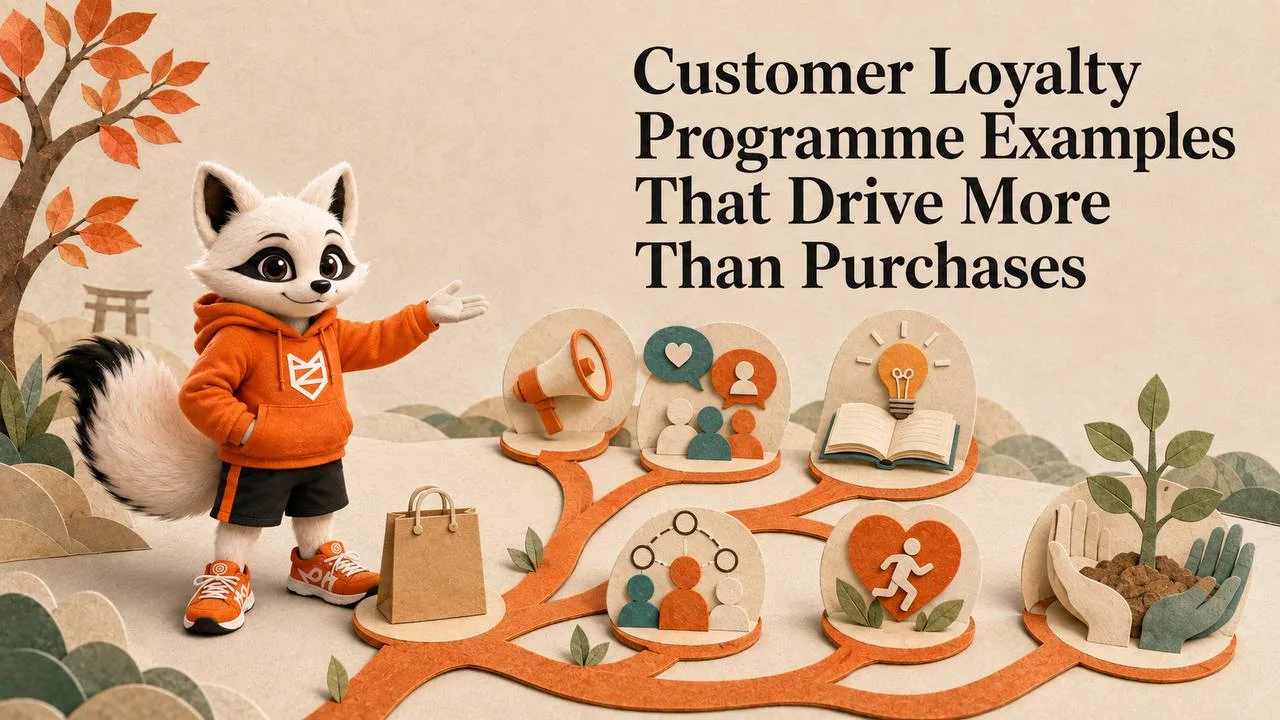
Customer Loyalty Programme Examples That Drive More Than Purchases
Every "loyalty programme examples" article you'll find online recycles the same ten brands in the same order. I'm going to do something slightly different: group them by what they actually reward, because that's the decision that matters, not the logo. If you're building or rebuilding a programme, the model you pick determines everything downstream. Here's what's actually working, organised by what the customer has to do to get something back.
Points based: reward the spend
The oldest model, and still the most common, because it's the easiest to explain to a customer in one sentence.
Starbucks Rewards is the reference case. Per Starbucks' own SEC filing for Q1 FY2025, 90-day active US members hit 34.6 million, up 1% year over year, and later climbed to an all time high of 35.5 million by Q1 FY2026. Members drive roughly 41% of US Starbucks sales. Here's the detail most articles skip: stored prepaid value on the Starbucks app reached $1.85 billion by March 2025, and the prepaid card liability sat at $1.78 billion at fiscal 2025 close. Customers are effectively lending Starbucks money interest free, in exchange for the promise of free coffee later. It's a genuinely clever piece of financial engineering dressed up as a rewards card.
Sephora Beauty Insider hit a record 45 million North American members in 2025 (per SVP Emeline Berlind), driving roughly 80% of Sephora's transactions through a tiered Insider, VIB, Rouge structure. This is points based loyalty done about as well as it can be done, with genuine status stakes attached to the tiers.
Tiered and status based: reward the relationship
Marriott Bonvoy spans hotels, an airline partnership, and credit cards, with 230 million plus members. Tiered programmes work because status is a stickier incentive than a discount. Nobody brags about a coupon. People genuinely do mention their airline status at dinner parties, which tells you something about how deep this incentive runs.
Membership and subscription: reward the commitment upfront
Amazon Prime has over 200 million members globally, and Prime members typically spend roughly double what non-member Amazon customers spend. This model flips the usual logic: instead of earning your way to a reward, you pay upfront for guaranteed value, and the psychological commitment does a lot of the retention work by itself.
Gamified: reward the engagement
Nike Run Club has more than 40 million active users, and app users show around 30% higher retention than customers who just buy Nike products without engaging with the app. It works because the reward isn't a discount code, it's a trophy for a genuine achievement.
McDonald's Monopoly has been running since the late 1980s. Nearly forty years is an extraordinary run for a promotional mechanic, and it's survived because peeling a sticker off a fry box triggers something in the brain that a loyalty app notification never quite manages.
Duolingo's streak mechanic is the most cited example of habit-forming gamification in any category, loyalty included, and it's worth studying even if you've never learned a language on it.
Action based and purpose led: reward the behaviour
This is the category growing fastest and covered least, which is exactly why I'm giving it the most space here.
Sweatcoin has 150 million users converting 1,000 verified steps into a Sweatcoin, redeemable for gear, discounts, or charity donations. A study in the British Journal of Sports Medicine found it associated with roughly a 20% increase in users' physical activity levels, which is a genuinely rare thing in this list: peer reviewed evidence that a loyalty mechanic changed real world behaviour, not just spend.
Etihad's Conscious Choices, launched January 2022 and billed by Etihad as the world's first green loyalty programme, awards Tier Miles for carbon offsetting, packing lighter, or donating miles to environmental causes. Etihad's VP of Loyalty told Point Hacks the programme had driven over $35,000 of carbon offsets from members. That figure is self reported, not independently audited, so treat it as a claim rather than a verified fact, but the mechanic itself is the interesting part: miles for behaviour, not spend.
F45 Training's FIT Rewards, launched September 2025, awards points, which F45 calls "Loyals," for workouts and for non purchase actions like sharing heart rate data or completing challenges. It's brand new, so there's no outcome data yet, but the design is worth watching.
24 Hour Fitness FitPerks, launched August 2024, rewards gym check-ins and class attendance rather than membership renewal alone. The pitch, in the brand's own words, is "more movement, more often."
Patagonia's Action Works connects customers to environmental volunteering rather than offering a discount. Patagonia's own benefit corporation report shows it funded roughly 12,000 hours of skill based volunteering worth $2.2 million in FY2024, and the brand ranked third in KPMG's 2024-25 US customer experience survey, up 16 places year over year.
TOMS ended its original one for one shoe donation model in 2020 and now commits a third of its profits to grassroots causes, a structural shift from "buy this, we'll donate that" to something closer to ongoing accountability.
Circularity mechanics are a quieter, cheaper version of the same idea: Kiehl's stamps a card for every empty product a customer returns for recycling, Beer Hawk rewards returned kegs, Costa Coffee adds bonus points for reusable cups, and Madewell offers a discount for returning old jeans. None of these require a platform overhaul. They're proof that action based rewards can start small.
What the pattern tells you
Look at where the peer reviewed evidence sits. It's not in the points programmes. It's Sweatcoin, funded by British Journal of Sports Medicine research, showing an actual behaviour change. That's not a coincidence. Rewarding an action gives you a much clearer signal that something real happened than rewarding a purchase does, because purchases were often going to happen anyway.
This is the logic behind Zenko: reward learning, movement, shopping, play, and purpose led choices directly, verify the action happened, and fund the reward through brand campaigns rather than discounting margin. If you want to see how that's built, our brands page has the detail. For the mechanics behind the games and streaks mentioned above, read how gamification makes loyalty more engaging. If you're deciding whether to build a programme like this yourself or license the tech, the white label guide covers that trade off. And if you want the unfiltered evidence on whether any of this actually retains customers, read the retention piece.
FAQ
What's the difference between a points programme and an action based programme?
A points programme rewards spend, usually a fixed amount of points per pound or dollar spent. An action based programme rewards specific behaviours, movement, learning, volunteering, sustainable choices, whether or not a purchase happened at all.
Which loyalty model has the strongest evidence behind it?
It depends what you're measuring. Points programmes like Starbucks Rewards have the strongest revenue data. Action based programmes like Sweatcoin have rarer but more compelling behavioural evidence, including peer reviewed research showing measurable activity increases.
Are gamified loyalty programmes actually more effective, or is that just marketing?
There's real data behind it. A 2025 Mastercard and CataBoom study found a 50% increase in session time and a 22% drop in churn from gamified mechanics. That's independent of any single vendor's own marketing claims.
Do sustainability linked loyalty rewards actually change behaviour?
Some do. Sweatcoin's step rewards are linked in peer reviewed research to a roughly 20% activity increase. Etihad's carbon offset figures are self reported and unaudited, so treat programme specific impact claims individually rather than assuming they're all equally verified.