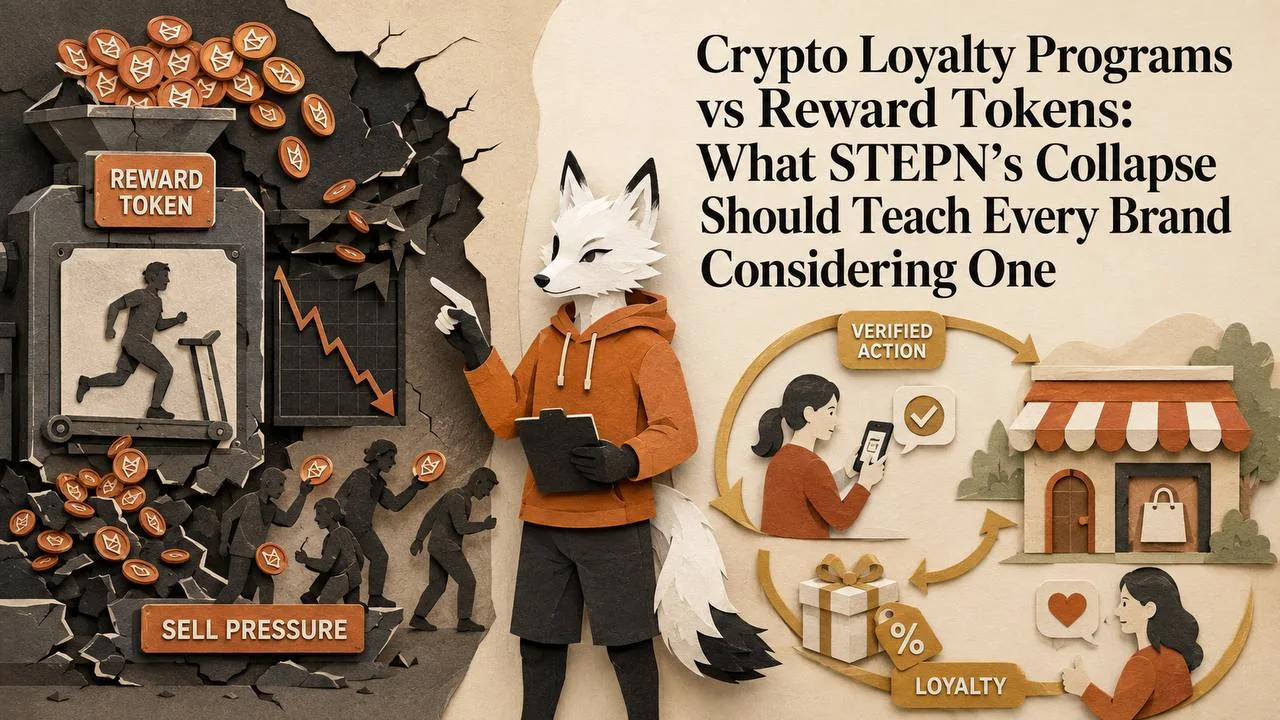
"Crypto loyalty program" gets used for two genuinely different things, and conflating them is how well-intentioned programmes end up structurally doomed. One rewards a verified real-world action with a token tied to a real outcome. The other rewards activity with a token whose value depends on new users continuing to join. The second model has a well-documented failure pattern, and any brand evaluating a crypto loyalty programme should be able to tell which one it's looking at.
This piece is part of Zenko's Web3 loyalty series, alongside Web3 Loyalty Programs: Why Verified Action Beats Quest Farming in 2026.
The STEPN collapse
STEPN's move-to-earn model let users earn GST and GMT tokens for walking, running, or cycling while wearing an in-app NFT sneaker. It grew explosively: monthly active users peaked at roughly 700,000 in May 2022. Less than a year later, in February 2023, that figure had fallen to around 43,000, a collapse of over 90%, alongside GST and GMT prices that had also fallen more than 90% from their highs, per Dune Analytics data reported at the time.
The mechanism is structural, not incidental. Move-to-earn token rewards are typically funded by new users buying into the ecosystem, through NFT purchases, in-app spend, or token buys. When user growth slows, the token supply keeps expanding while new demand doesn't, and price collapses. Once the token is worth less, the reward for "earning" it shrinks, which reduces the incentive to keep playing, which slows growth further. It's the same structure as a lot of pyramid-shaped token economies, wearing a fitness app.
STEPN wasn't alone. Sweatcoin, one of the earlier fitness-token apps, pivoted away from crypto payouts toward gift cards. Genopets and Walken, both move-to-earn projects, have gone largely quiet.
The distinction that matters: what is the reward actually tied to?
The failure isn't "rewarding real-world action with a token." It's specifically rewarding real-world action with a token whose value depends on continuous new-user inflow, the same structural weakness as any pyramid-shaped economy. A reward model avoids this trap when the value behind the reward comes from somewhere other than the next cohort of joiners.
Two structurally different models often get called "crypto loyalty" or "earn" programmes:
| Speculative earn model (e.g. STEPN) | Verified-action model funded by campaign budgets | |
|---|---|---|
| What triggers the reward | An action inside the app (steps, taps) | A verified real-world action (purchase, completed course, confirmed activity) |
| Where the reward's value comes from | New users buying into the token/NFT economy | A brand's existing marketing or CSR budget, paid regardless of new-user growth |
| What happens if user growth slows | Token price falls, rewards shrink, more users leave (death spiral) | Nothing structural changes; the brand still pays for verified actions taken |
| What the user actually gets | A token whose value is speculative | A token backed by real campaign spend, plus, in Zenko's model, a measurable real-world outcome like a funded meal or a planted tree |
Zenko's model sits in the second column deliberately. Rewards are funded by brand campaign budgets already earmarked for marketing or ESG spend, not by new users buying into a token economy, which is the same reason HP's 35% cost-per-lead reduction and Lenovo's move from $140 to $90 cost-per-lead held up at scale rather than depending on an ever-growing pool of new participants.
Why this distinction is hard to see from the outside
Both models can look identical in a pitch deck: "users earn tokens for real-world actions." The difference only shows up in where the money funding the reward actually comes from, and that's rarely disclosed upfront. Before treating any "crypto loyalty" or "earn" programme as comparable to a traditional loyalty scheme, it's worth asking directly where the reward budget originates, and what happens to the reward's value if new-user growth slows to zero next quarter. If the honest answer involves the token's own price, treat it as speculative, regardless of how the marketing describes it.
FAQ
Is Zenko's model the same as move-to-earn apps like STEPN? No, on the specific point that caused STEPN's collapse: STEPN's rewards depended on the GST/GMT token's price, which depended on new-user inflow. Zenko's rewards are funded by brand campaign budgets, independent of new-user growth, and tied to a verified action with a measurable real-world outcome.
Why did STEPN's user base fall by more than 90%? Its move-to-earn token rewards were funded largely by new-user spending on NFTs and tokens. When new-user growth slowed, token prices collapsed too, also more than 90% from highs, which shrank the reward's value and accelerated user departures, a self-reinforcing decline documented in Dune Analytics data from early 2023.
What question should a brand ask before adopting a "crypto loyalty" program? Where does the money funding the reward come from, and does that funding depend on the number of new users joining? If yes, the model shares STEPN's structural weakness regardless of how it's marketed.